
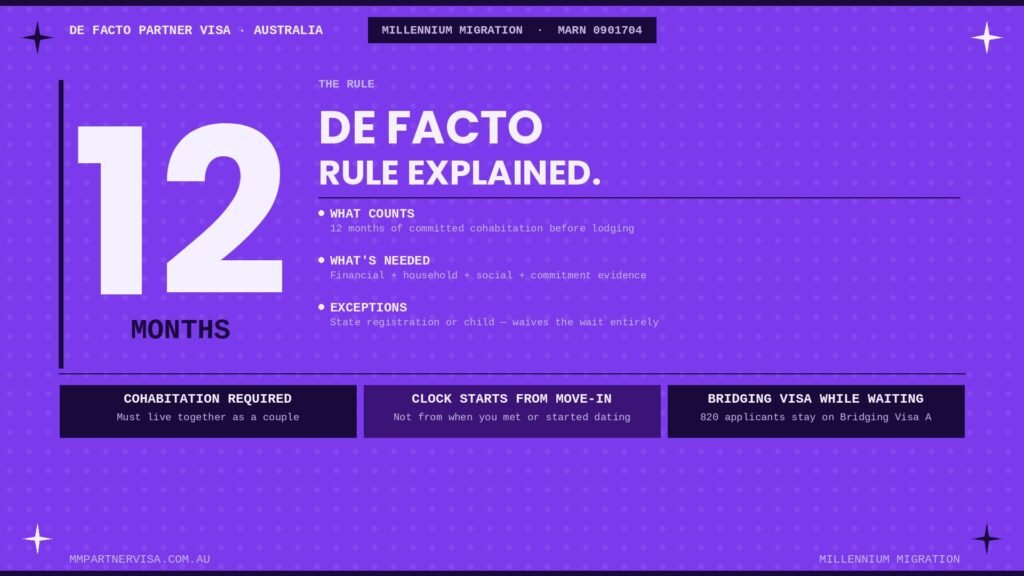
If you’re applying for a partner visa as a de facto couple, the 12-month de facto rule is the single most important eligibility test you face.
Get it wrong and your application fails. Get it right and you’re on solid ground.
Here’s exactly what it means and how to satisfy it in 2026.

Key takeaways
- The 12-month de facto rule requires you to have lived in a committed relationship for at least 12 months immediately before lodging your partner visa.
- The clock counts the substantive de facto period—not dating, knowing each other, or being in a long-distance relationship.
- Three exemptions skip the rule entirely: relationship registration, having a child together, or compelling circumstances.
- Lodging even one day too early is a common reason for refusal. The Department applies the rule strictly.
- Married couples do not need to satisfy this rule—a marriage certificate replaces the 12-month requirement.
In this guide
- What the 12-month de facto rule actually is
- How the 12 months is counted
- What counts as de facto time (and what doesn’t)
- Exemption 1: Relationship registration
- Exemption 2: A child of the relationship
- Exemption 3: Compelling circumstances
- How to prove the 12 months
- Common mistakes that fail the rule
1. What the 12-month de facto rule actually is
The rule comes from Regulation 2.03A of the Migration Regulations 1994. It states that a de facto partner visa applicant must have been in a de facto relationship with their sponsor for at least 12 months immediately before the application is lodged.
Therefore, the rule has three precise requirements:
- A de facto relationship as defined in Section 5CB of the Migration Act.
- A continuous period of at least 12 months.
- That period must run immediately up to your lodgment date (not at some earlier point in time).
*Note: This rule applies only to unmarried couples or couples who do not have their relationship registered. If you are legally married or have registered your relationship, a valid marriage certificate replaces the 12-month requirement entirely.*
2. How the 12 months is counted
The Clock Starts at “De Facto,” Not Dating: This is where most couples go wrong.
The 12 months counts from when your relationship actually became a committed shared life—not from when you met or started dating.
For example, if you dated long-distance for 6 months and finally moved in together in September, your de facto period starts in September.
Tracking Continuous Timeline Requirements
It Must Be Unbroken:
The 12 months must be continuous. A formal break-up followed by reconciliation resets the clock. However, brief separations for legitimate reasons (such as work travel or family emergencies) do not reset your timeline. Consequently, keeping robust evidence during these brief times apart remains absolute critical for absolute transparency.
It Must End at Lodgment:
You cannot satisfy this rule retrospectively. Lodging at the 11-month mark hoping the wait time will fix it does not work. The Department assesses your eligibility at the lodgement date only. Furthermore, the Department strictly checks this on day one, meaning an early application leads directly to a refusal notice and a loss of your non-refundable visa application charge.

Photo via Unsplash
3. What counts as de facto time (and what doesn’t)
Section 5CB of the Migration Act 1958 defines a de facto relationship by four tests. All four must be met:
- Mutual commitment to a shared life to the exclusion of all others.
- The relationship is genuine and continuing.
- You and your partner aren’t related by family.
- You live together, or don’t live separately on a permanent basis.
What counts: Living together in a shared home, sharing finances, sharing household duties, and being recognized socially as a couple.
What doesn’t count: Long-distance online dating, casual dating without shared commitment, or periods where you broke up.
4. Exemption 1: Relationship registration
This is the most powerful and frequently used exemption. Registering your relationship with an Australian state authority waives the 12-month rule completely.
- Where you can register: New South Wales, Victoria, Queensland, South Australia, Tasmania, and the ACT.
- Where you can’t: Western Australia and the Northern Territory do not currently offer a registration scheme that waives the migration requirement.
- Processing time: Most states have a 28-day cooling-off period, meaning it takes about a month to receive your certificate before you can lodge your visa.
5. Exemption 2: A child of the relationship
Having a biological or legally adopted child together waives the 12-month rule entirely. You can also lodge while the child is yet to be born, provided you supply medical proof of the pregnancy.
The reasoning is practical: a shared child is some of the strongest possible evidence of a committed relationship, so the Department waives the cohabitation timeline. However, a child from a previous relationship of just one partner does not qualify.
6. Exemption 3: Compelling circumstances
In rare and strict cases, the Department may waive the 12-month rule for compelling reasons. Examples include:
- Legal or safety barriers preventing you from living together in your home country (e.g., LGBTQ+ persecution).
- Forced separation due to war or natural disaster.
- Serious illness preventing cohabitation.
The Department does not publish a clear test for this, and claims like busy careers or family disapproval will not pass. Always seek legal migration advice before attempting to use this exemption.
7. How to prove the 12 months

Photo via Unsplash
If you are relying on the 12-month timeline, you must show a consistent paper trail across the four core pillars:
- Financial: Joint bank accounts with active shared use, shared bills, or mutual insurance policies. Furthermore, with the base Department of Home Affairs application charge sitting at AUD $9,365 in 2026, solid financial co-mingling protects this massive upfront investment.
- Household: A joint lease or mortgage, utilities in both names, and mail sent to the same address.
- Social: Form 888 statutory declarations from family and friends, joint travel records, and photos.
- Commitment: Statutory declarations from both partners outlining your history, future plans, and wills.
8. Common mistakes to avoid
- Lodging Even One Day Too Early: The rule is calculated to the day. If your de facto life started on 15 March, you cannot lodge until 15 March the following year. Because of the strict standard, lodging early results in an automatic refusal.
- Counting Online Time: Daily messages while living in separate countries do not establish a physical “shared life.”
- Inconsistent Timelines: If the statements from the applicant and the sponsor list different dates for when the relationship became serious, the Department will flag the application.
Take the free 2-minute quiz to find out — or read the complete partner visa guide for the full eligibility framework.
About the author
Sam is the founder of Millennium Migration, based in Melbourne. He assists clients across Australia with complex partner, family, and migration matters.
Sources
- Migration Regulations 1994 (Cth) — Regulation 2.03A
- Migration Act 1958 (Cth) — Section 5CB
- Department of Home Affairs — Partner visa overview
This article provides general information only and is current as of May 2026. It does not constitute personal migration advice. Always verify current requirements with a Registered Migration Agent.