
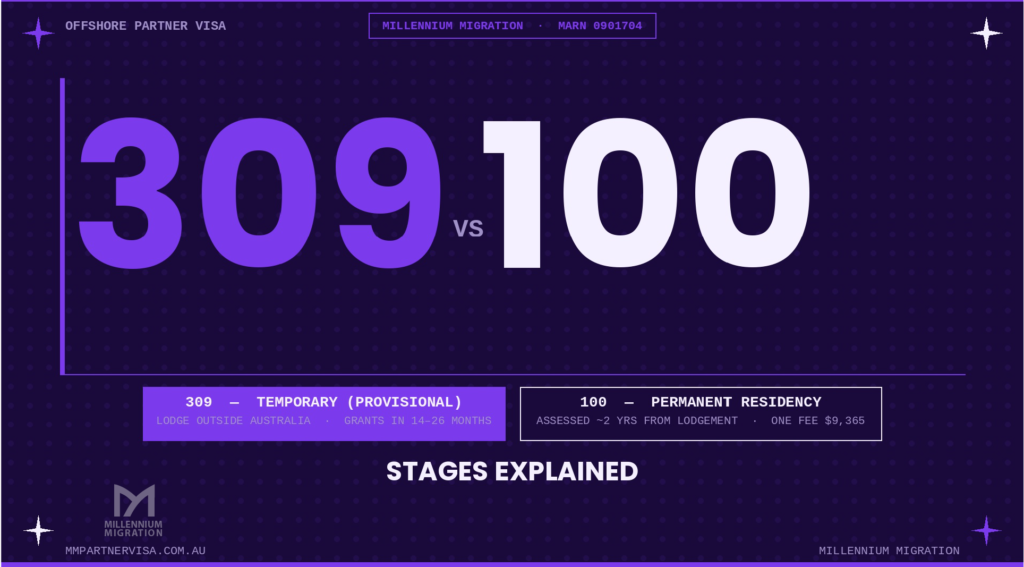
Applying for a partner visa from outside Australia? The subclass 309 vs 100 pathway is what you need to understand. You’re actually applying for two visas at once — the temporary 309 and the permanent 100. So how does each stage work, and what makes the offshore pathway different from the onshore route?

Key takeaways
- Understanding subclass 309 vs 100: the 309 is the temporary (provisional) offshore stage. Meanwhile, the 100 grants permanent residency. You apply for both at once and pay one fee.
- You must be outside Australia when you lodge. However, a 2024 rule update means Home Affairs can now grant the 309 whether you’re inside or outside Australia at decision time.
- Processing in 2026: the 309 typically takes 14–26 months. The 100 then takes around 9–18 months after eligibility.
- Once you receive the 309 grant, you can travel to Australia and live there with full work and study rights.
- The base fee is AUD $9,365 for 2025–26 — covers both stages, paid once at lodgement.
In this guide
- Why the offshore pathway exists
- The 309 — temporary stage explained
- The 100 — permanent stage explained
- 309 vs 100 side by side
- The full timeline from lodgement to PR
- Offshore vs onshore — which to choose
- Travelling to Australia after the 309
- Evidence at the 100 stage
- What can go wrong
- Frequently asked questions
1. Why the offshore pathway exists
The subclass 309 vs 100 pathway exists for one practical reason. Most international relationships start with the partners living in different countries. As a result, the non-Australian partner has no legal way to stay inside Australia long-term while their application is processed.
So the law creates a route that lets the application happen from overseas. The applicant only needs to travel once their temporary visa is granted.
Like the onshore pathway, this route works in two stages. In fact, the Department of Home Affairs assesses your relationship at two different points in time: once at lodgement, and again around two years later. This way, they verify the relationship is genuine and continuing — not just real on paper at a single moment.
Critical to understand: the 309 and 100 form one combined application. You don’t lodge twice. You don’t pay twice. Instead, you apply once from outside Australia, and Home Affairs assesses each stage at the appropriate time.
2. The 309 — temporary stage explained
What the 309 is
The subclass 309 Partner (Provisional) visa is the first stage of the offshore partner visa pathway. To lodge, you must be physically outside Australia.
However, a 2024 rule update is worth knowing about: Home Affairs can now grant the 309 whether you’re inside or outside Australia at decision time. Previously, you had to be outside Australia at grant. Now you can visit your sponsor on a tourist visa while waiting and still receive the 309 grant during that visit. For separated couples, this represents a major practical improvement.
Once granted, the 309 lets you travel to Australia and stay until Home Affairs decides on your 100. It doesn’t have a fixed expiry. Instead, it remains in effect until the permanent stage is decided.
What the 309 lets you do
- Travel to and live in Australia — finally being with your sponsor
- Work for any employer in any role, with no limits on hours
- Access Medicare from the day you arrive in Australia
- Study — usually at international student fees until you reach permanent residency
- Travel in and out of Australia as many times as you like
- Sponsor eligible family members for visiting visas
309 processing time in 2026
| Percentile | Processing time (309) |
|---|---|
| 25% of applications decided within | ~9 months |
| 50% (median) | ~14 months |
| 90% of applications decided within | ~26 months |
What affects your processing time
Decision-ready applications sit at the faster end. These are the ones lodged with all evidence, health checks, and police clearances complete from day one. By contrast, applications that trigger Section 56 requests for further information sit at the slower end. Country of application also matters — some embassies process faster than others.
Source: Department of Home Affairs — Partner visa (apply overseas)

3. The 100 — permanent stage explained
What the 100 is
The subclass 100 Partner (Migrant) visa is the second stage. It grants you Australian permanent residency.
However, you don’t lodge a new application for the 100. You don’t pay a new fee either. Instead, the 100 was already part of your original combined application. At the 100 stage, Home Affairs re-assesses your relationship based on updated evidence you provide.
The 100 typically becomes eligible for assessment around two years after your original 309/100 lodgement date. Importantly, that’s two years from lodgement, not from grant. So if your 309 took 18 months to grant, the 100 becomes assessable just 6 months later.
What the 100 gives you
- Permanent residency — the right to live in Australia indefinitely
- Pathway to citizenship — generally after 4 years of residence including 12 months as a PR
- Domestic student fees at universities and TAFE
- Centrelink access after the relevant waiting periods
- HECS-HELP for tertiary study
- Sponsor others for permanent visas (parents, children, future partners — subject to limits)
- 5-year initial travel facility — leave and return for 5 years before needing a Resident Return Visa
100 processing time
The 100 stage moves faster than the 309. After all, Home Affairs already established the relationship was genuine at the start. Most 100 decisions happen within 9–18 months of becoming eligible.
4. Subclass 309 vs 100 side by side
| Subclass 309 | Subclass 100 | |
|---|---|---|
| Type | Temporary (provisional) | Permanent residency |
| Where you lodge from | Outside Australia | Outside Australia (lodged with 309) |
| Where you must be at grant | Inside or outside Australia | Inside or outside Australia |
| When assessed | First (14–26 months after lodgement) | ~2 years after original lodgement date |
| Separate application? | No — combined with 100 | No — already part of original lodgement |
| Separate fee? | No — single $9,365 charge | No — covered by original charge |
| Work rights | Full (once in Australia) | Full |
| Medicare | Yes (from arrival) | Yes (full) |
| Citizenship pathway | No (need PR first) | Yes |
| Travel rights | Yes (multiple entry) | Yes (5-year travel facility) |
5. The full timeline from lodgement to PR
Here’s what the subclass 309 vs 100 journey looks like for a typical applicant in 2026:
You lodge the combined 309/100 from outside Australia. Then you pay the $9,365 fee.
Home Affairs decides your provisional visa. Now you can travel to Australia.
Two years after lodgement, the permanent stage opens. Then Home Affairs requests updated evidence.
After reviewing the updated evidence, Home Affairs grants permanent residency.
The full lodgement-to-PR journey usually takes 2 to 4 years for offshore applicants. Faster for couples with strong evidence and uncomplicated histories. Conversely, slower if there’s a Section 56 request, country-specific delays, or any complications during the wait.
6. Offshore vs onshore — which to choose
The choice between offshore (subclass 309 vs 100) and onshore (820/801) usually isn’t a free choice. Instead, it’s determined by where you happen to be when you’re ready to lodge. However, a few situations give applicants a real decision to make.

When offshore (309/100) usually makes sense
- You’re already living overseas with no easy way to travel to Australia
- You don’t currently hold an Australian visa allowing onshore lodgement
- You want to keep working in your home country while the application processes
- Your sponsor wants to stay in Australia with kids or work, and you’ll join them once the 309 is granted
When onshore (820/801) usually makes sense
- You’re already in Australia on a valid visa and can stay on a Bridging Visa A
- You want to keep living and working in Australia throughout the wait
- You can satisfy Schedule 3 if applying without a substantive visa
For a complete breakdown of the choice, see our complete partner visa guide — section 5 covers onshore vs offshore in depth.
Take our free 2-minute quiz and we’ll tell you in plain English.
Take the Quiz →7. Travelling to Australia after the 309
Once you receive your 309 grant, you can travel to Australia and stay until the 100 is decided. Meanwhile, here are a few practical things worth knowing.
First entry deadline
Your 309 grant letter will specify a “first entry by” date — usually within 12 months of grant. Importantly, you must enter Australia at least once before that date or the visa lapses. Once you enter, however, the visa remains in effect indefinitely until the 100 is decided.
Setting up Medicare
Apply for Medicare from the day you arrive. You’ll need your 309 grant letter, passport, and proof of address. Most 309 holders qualify immediately on arrival.
Tax File Number, banking, the basics
Apply for a Tax File Number through the ATO website on day one. Then open a bank account — joint accounts with your sponsor are valuable evidence for the 100 stage. Also get a Medicare card. Finally, update your address with Home Affairs through ImmiAccount.
Travel in and out of Australia
The 309 is a multiple-entry visa. So you can leave and return as often as you like while it remains in effect. Just check your visa’s travel facility before departing. Most 309s don’t have travel restrictions, but your specific grant letter will tell you.
8. Evidence at the 100 stage — what’s different
It’s not a re-test from scratch
The 100 stage isn’t a re-test of your relationship from scratch. After all, Home Affairs already accepted that your relationship was genuine at the start. Instead, what they want to see at the 100 stage is that the relationship has continued and developed.
The key word is continuing. New documents only. Recent photos. Updated joint accounts. A current lease in Australia. However, the most common error is to resubmit the same evidence package from the 309 stage, slightly updated. As a result, Home Affairs may issue a Section 56 request — adding months to the wait.
What Home Affairs typically asks for
- Updated joint financial documents (bank statements from the last 12 months, joint super or insurance, joint tax records)
- Australian household evidence (current lease, utility bills, mail to both partners at one address)
- Photos and social proof from the post-309 period — showing life together in Australia
- One or two new Form 888 statutory declarations from witnesses (preferably Australian-based) who can speak to the period since arrival
- Updated relationship statements from both parties
9. What can go wrong
The 309 grant isn’t the finish line. Rather, it’s the halfway point. Several things can derail an offshore application before the 100 is granted.
The relationship breaks down
If you and your sponsor separate before the 100 is granted, the application doesn’t automatically end. Limited pathways may allow you to continue:
- Family violence provisions — if you’ve experienced family violence from your sponsor, you may continue under these provisions even after separation
- Shared-child pathway — if you have a child with your sponsor
- Death of sponsor — if your sponsor has passed away
First-entry date is missed
If you don’t enter Australia by the first-entry deadline on your 309, the visa lapses. As a result, you’d need to apply again — losing the fee and starting over.
Material changes aren’t disclosed
Address changes, employment changes, marriage (if you lodged as de facto), birth of a child, character matters arising — all need notification through ImmiAccount. Failing to disclose can be treated as withholding information. In turn, this can trigger a PIC 4020 issue (misleading information), leading to refusal at the 100 stage.
The 100 evidence is too thin
Couples who don’t keep building evidence after arrival in Australia struggle at the 100 stage. For example, if the only joint document from your time together in Australia is one lease and a Medicare card, Home Affairs may question whether the relationship is genuine and continuing.
10. Frequently asked questions
Do I have to stay outside Australia until the 309 is granted?
No, not anymore. A 2024 rule update means Home Affairs can now grant the 309 whether you’re inside or outside Australia at the time of decision. So you can visit your sponsor on a tourist visa (e.g. subclass 600 or eVisitor 651) while waiting. Just don’t overstay your tourist visa or breach its conditions — that creates separate problems.
Do I have to apply for the 100 separately?
No. The 100 was already part of your original 309/100 application. So you don’t lodge again or pay again. Around two years after your original lodgement date, Home Affairs will contact you through ImmiAccount asking for updated evidence to assess the 100.
When does the 2-year clock start — at lodgement or at 309 grant?
At lodgement. The 2-year window for 100 eligibility is calculated from the date you lodged the original 309/100 application — not the date the 309 was granted. So if your 309 took 18 months to grant, the 100 becomes assessable just 6 months after grant.
Can I work in Australia before the 309 is granted?
No. The 309 is the first visa that gives you Australian work rights. Until it’s granted, you cannot work in Australia (unless you separately hold a working holiday or other work-permitted visa). If you’re visiting on a tourist visa while waiting, you must not work.
Can I switch from 309 to 820 or vice versa?
Not directly. They’re different applications. However, if your circumstances change significantly — for example, you’ve moved to Australia long-term and won’t return — you can withdraw the offshore application and lodge an onshore one. But you’d lose the original fee, so this is rarely worth doing.
Do offshore applicants need an English test?
No mandatory English test pass mark applies for the 309/100 in 2026. However, “functional English” is encouraged for the 100 stage. You can demonstrate functional English through evidence of education, employment, or completing 510 hours of free Adult Migrant English Program tuition after arrival.
What if my 309 takes longer than 2 years?
If the 309 hasn’t been decided by the 2-year mark, Home Affairs may simply assess both stages together at the next decision point — granting you the 309 and 100 simultaneously. This is sometimes called a “double grant” or long-term relationship exception.
What happens to my visa if my relationship ends?
It depends on why it ended. If it ended due to family violence, you may continue under the family violence provisions. Alternatively, if you have a child with your sponsor, the shared-child pathway may apply. If your sponsor has died, the deceased-sponsor pathway may apply. If none of these apply, you may need to withdraw the application.
Can my 100 be refused if my 309 was granted?
Yes. A 309 grant doesn’t guarantee a 100 grant. After all, the 100 is a fresh assessment of whether your relationship is still genuine and continuing. Common reasons for 100 refusal include: relationship has ended, evidence is too thin, character or health issues have arisen, or material change of circumstances wasn’t disclosed.
Can I include my children in the 309/100 application?
Yes. Dependent children can be included in the original application as additional applicants (with an additional applicant charge). However, if you have a child after the 309 is granted, you can usually add them through a Dependent Child (subclass 445) visa or include them at the 100 stage. Timing matters — speak to a registered migration agent if a child is born during the wait.
Take the free 2-minute quiz to see if subclass 309 vs 100 is right for you. Or read the in-depth offshore partner visa guide for the full process.
Related reading
About the author
Sam is the founder of Millennium Migration, based in Melbourne. He assists clients across Australia with partner, family and complex migration matters.
Sources
- Department of Home Affairs — Partner visa (apply overseas) (subclasses 309 and 100)
- Department of Home Affairs — Subclass 309 Partner (Provisional)
- Department of Home Affairs — Visa processing times
- Migration Act 1958 (Cth) and Migration Regulations 1994 (Cth)
This article provides general information only and is current as of [Month Year]. It does not constitute personal migration advice. Australian migration law changes frequently — verify current requirements at immi.homeaffairs.gov.au. For advice on your specific situation, take our quiz or contact Sam at Millennium Migration directly.