
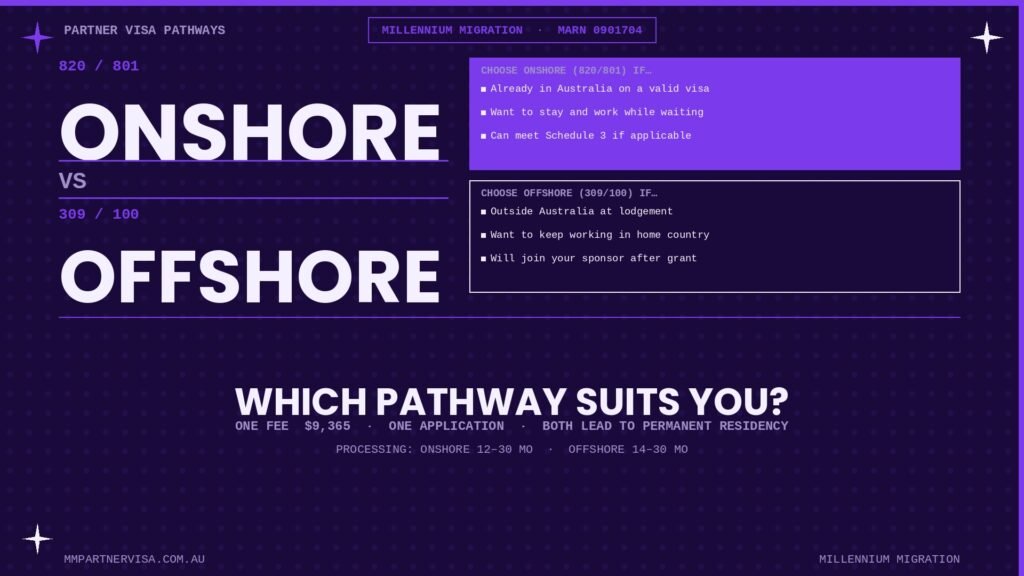
Choosing between an onshore vs offshore partner visa isn’t always a free choice — but when it is, the decision affects your work rights, where you live during processing, and even the costs you’ll face. Here’s how to know which pathway suits your situation in 2026.

Key takeaways
- The onshore vs offshore partner visa choice depends mainly on where you are physically located when you lodge.
- Onshore (820/801) = lodge from inside Australia. You stay during processing on a Bridging Visa A with full work rights.
- Offshore (309/100) = lodge from outside Australia. You stay overseas (or visit on a tourist visa) until granted.
- Both fees are the same: AUD $9,365 for 2025–26.
- Processing in 2026: 820 takes 12–24 months, 309 takes 14–24 months — broadly similar.
- Onshore offers continuity in Australia. Offshore offers lower living costs in your home country during the wait.
In this guide
- The core difference: where you lodge
- Onshore partner visa (820/801) explained
- Offshore partner visa (309/100) explained
- Onshore vs offshore: side-by-side comparison
- Which one actually suits you?
- Hidden costs and lifestyle factors
- Can you switch between them?
- Your 5-question decision checklist
- Frequently asked questions
1. The core difference: where you lodge
The onshore vs offshore partner visa distinction comes down to one simple fact. Your physical location when you submit your application determines your stream.
If you click “submit” while inside Australia, you apply for the onshore stream (subclass 820/801). Meanwhile, if you click “submit” from outside Australia, you enter the offshore stream (subclass 309/100). Your nationality does not matter. Moreover, your intended residence does not change the rule. Only your physical location at the moment of lodgement matters.
This rule remains strict. Lodging in the wrong stream isn’t just a minor error. In fact, it makes the application invalid. As a result, you would lose the application fee and must start the process over from the beginning.
Key 2026 update: While you must still lodge offshore for the 309, Home Affairs can now grant the 309 whether you’re inside or outside Australia at decision time. So you can visit your sponsor on a tourist visa while waiting and still receive the grant during that visit.
2. Onshore partner visa (820/801) explained
How the onshore pathway works
The onshore partner visa suits couples who are already together in Australia. Perhaps you hold a Student visa, a Working Holiday visa, or a visitor visa. Now, you wish to apply for permanent residency together without leaving the country.
You lodge while physically present in Australia. Once Home Affairs receives your application, they typically grant a Bridging Visa A (BVA) automatically. This BVA allows you to stay lawfully and work full-time while the Department processes your application.
Onshore advantages
- Stay together in Australia during processing
- Full work rights on Bridging Visa A — no time limits, any employer
- Medicare access from lodgement (you can enrol immediately)
- Continuity of life — keep your job, lease, social network
- Earn Australian wages during the wait
Onshore disadvantages
- You can’t leave Australia on a Bridging Visa A — you’d need to apply for a Bridging Visa B (BVB) before each trip
- Higher living costs in Australia during processing (especially Sydney, Melbourne)
- Schedule 3 may apply if you’re applying without a substantive visa
- Visa condition 8503 (“no further stay”) on your current visa blocks onshore lodgement

3. Offshore partner visa (309/100) explained
How the offshore pathway works
The offshore partner visa assists couples where the applicant resides overseas. You lodge from outside Australia — anywhere in the world — and wait for the decision while staying in your home country or abroad.
Unlike the onshore pathway, you do not receive a bridging visa. This happens because bridging visas only apply if you are already inside Australia. Consequently, you continue your life overseas and travel to Australia only after the 309 grant arrives.
Offshore advantages
- Stay in your home country during processing — usually cheaper living costs
- Keep your existing job, family, and support network at home
- Can visit Australia on a tourist visa while waiting (since 2024 change)
- Can be granted while inside Australia (since 2024 change) — major flexibility upgrade
- No Schedule 3 or visa condition complications
Offshore disadvantages
- Long-distance separation from your sponsor (sometimes 1–2 years)
- No Australian work rights until the 309 is granted
- No Medicare until you arrive in Australia
- Country-specific embassy delays can affect processing
4. Onshore vs offshore: side-by-side comparison
Here’s the onshore vs offshore partner visa comparison at a glance:
| Feature | Onshore (820/801) | Offshore (309/100) |
|---|---|---|
| Lodgement Location | Inside Australia | Outside Australia |
| Location at Grant | Inside Australia | Inside or outside |
| Bridging Visa | Yes (BVA) | No |
| Work Rights | Full rights immediately | Upon visa grant |
| Medicare Access | From lodgement | Upon arrival |
| Application Fee | $9,365 | $9,365 |
| Processing Time | 12–24 months | 14–24 months |
5. Which one actually suits you?

The onshore vs offshore partner visa question often answers itself based on your circumstances. Let’s walk through the most common scenarios.
Onshore (820/801) suits you if:
- You’re already in Australia on a valid visa (Student, Working Holiday, 482, etc.)
- Your visa doesn’t have condition 8503 (“no further stay”)
- You and your sponsor are already living together in Australia
- You want to keep working in Australia during the wait
- Leaving Australia would disrupt your career, study, or family situation
Offshore (309/100) suits you if:
- You’re currently outside Australia with no visa to enter
- Your sponsor lives in Australia and you’ll join them once granted
- You prefer to wait at home where living costs are lower
- You have a stable job overseas you don’t want to leave during the wait
- Your current Australian visa has condition 8503 (no further stay)
When it’s a real choice (not forced)
Some couples have flexibility. For example, one partner might hold a valid Australian visa but could also fly home to lodge. In these cases, the decision usually comes down to three factors:
- Continuity of life. Onshore wins if you’re settled in Australia. Offshore wins if you’re settled at home.
- Cost of living during the wait. Australian living costs are high. Consequently, if you wait at home for cheaper, offshore saves money.
- Earning power. Australian wages typically beat home-country wages. This often offsets higher costs. Thus, onshore can be financially better overall.
Take our free 2-minute quiz and we’ll tell you which pathway fits your situation.
Take the Quiz →6. Hidden costs and lifestyle factors
The application fee remains the same for both pathways. However, the real cost difference appears in lifestyle and earning factors during the wait.
Onshore: living in Australia
Average rent in major cities like Sydney runs $500–800 per week. Over 18 months, that totals $39,000–62,400. However, on a Bridging Visa A, you can earn full-time Australian wages. Most professional roles pay $50,000–80,000+ per year. Therefore, even with high costs, onshore applicants often come out ahead financially.
Offshore: living in your home country
Living costs abroad may be a fraction of Australian costs. Meanwhile, you can keep your existing job. The trade-off involves long separation from your sponsor. In fact, many couples find the emotional cost of a 2-year long-distance relationship more taxing than the financial one.
The emotional cost
Couples often overlook the emotional burden in cost comparisons. Long-distance during processing is difficult. Many couples describe the offshore wait as the most stressful period of their lives. As a result, they prioritize being together, which pushes them toward the onshore stream where possible.
7. Can you switch between them?
Direct switching is not possible. Once you lodge in one stream, you cannot move that specific application to the other. However, you can withdraw and re-lodge if your circumstances change significantly. Be aware that this carries high costs.
If you want to switch from offshore to onshore
You must enter Australia on a separate visa, such as a tourist visa. Then, you withdraw the offshore application and lodge a new onshore one. As a result, you lose the original $9,365 fee and must pay it again. Therefore, this only makes sense in extreme circumstances.
If you want to switch from onshore to offshore
You would need to leave Australia, withdraw your onshore application, and lodge offshore. Again, you would lose the original fee. This move rarely makes sense unless a family emergency abroad forces the relocation.
Get the choice right the first time. Because switching is expensive, the upfront decision matters. So if your situation is complex, getting professional advice before lodging usually saves more than it costs.
8. Your 5-question decision checklist
Run through these five questions to clarify which pathway suits you:
Question 1: Where are you right now?
If you’re in Australia on a valid visa, onshore is the default. If you’re overseas, offshore is the default.
Question 2: Does your current visa have condition 8503?
If yes, you cannot lodge onshore (without a hard-to-get waiver). So offshore is your pathway.
Question 3: Will you need to travel during the wait?
If you frequently need to travel for work or family reasons, the onshore pathway requires a Bridging Visa B for each trip. Meanwhile, offshore gives total flexibility outside Australia.
Question 4: Where can you earn more?
If your home-country earnings are higher than what you’d earn in Australia, offshore makes financial sense. For most countries, however, Australian wages win — so onshore is better financially.
Question 5: Can you handle the separation?
Honest answer here. If 12-24 months apart from your sponsor would damage your relationship, prioritise onshore wherever possible.
9. Frequently asked questions
Is onshore or offshore faster?
Broadly similar in 2026. The 820 takes 12–24 months and the 309 takes 14–24 months. Decision-readiness (lodging with all evidence complete) affects timing more than which stream you’re in.
Do I get the same final visa from both pathways?
Effectively yes. Both pathways lead to permanent residency with full work rights, Medicare, and a citizenship pathway. The final outcome (PR) is identical — only the journey differs.
Can I apply onshore on a visitor visa?
Sometimes. It depends on whether your visitor visa has condition 8503 (no further stay). Without 8503, an onshore application is generally possible, though Schedule 3 may apply if your visitor visa has expired by the time you lodge.
Can I visit Australia while my offshore application is processing?
Yes, on a separate visa such as a tourist visa. Since 2024, you can even be granted the 309 while inside Australia. However, you must not breach the conditions of your visitor visa (no work, leave before it expires, etc.).
Are the application fees the same for both?
Yes. Both onshore and offshore pathways cost $9,365 (2025–26 financial year base charge). The fee covers both stages — the temporary visa and the permanent visa.
What if I’m stuck with Schedule 3 onshore?
Schedule 3 can be waived in compelling circumstances. However, waivers are technically demanding and outcomes vary case by case. If Schedule 3 is a major risk, applying offshore (309/100) avoids it entirely, since Schedule 3 only applies to onshore applicants.
Take the free 2-minute quiz to find out whether the onshore vs offshore partner visa pathway fits your situation. Or read the in-depth pillar guide.
Related reading
About the author
Sam is the founder of Millennium Migration, based in Melbourne. He assists clients across Australia with partner, family and complex migration matters.
Sources
- Department of Home Affairs — Partner visa (apply in Australia)
- Department of Home Affairs — Partner visa (apply overseas)
- Department of Home Affairs — Visa processing times
- Migration Act 1958 (Cth) and Migration Regulations 1994 (Cth)
This article provides general information only and is current as of May 2026. It does not constitute personal migration advice. Australian migration law changes frequently — verify current requirements at immi.homeaffairs.gov.au. For advice on your specific situation, take our quiz or contact Sam at Millennium Migration directly.