
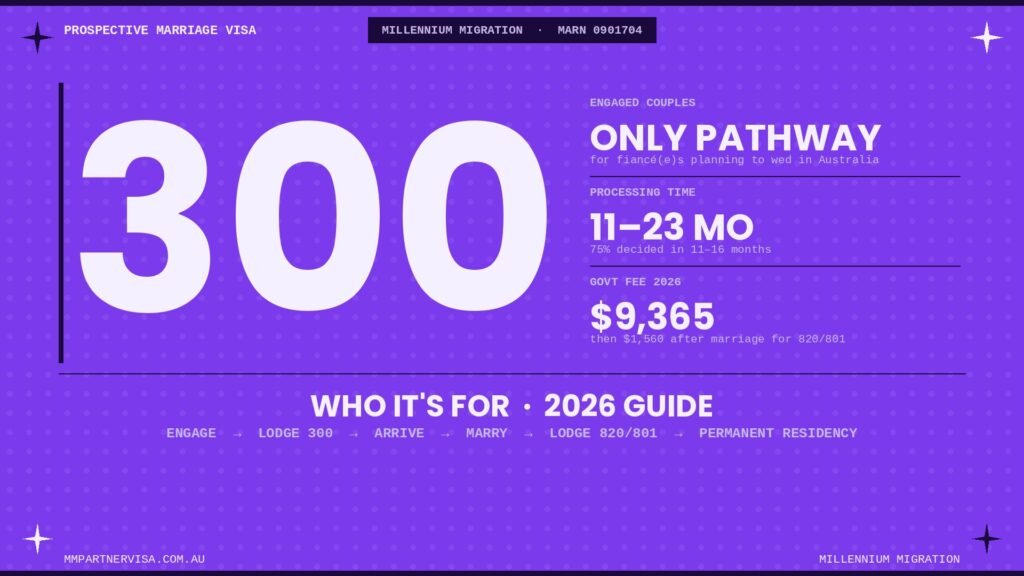
Engaged to an Australian and planning to marry in Australia? The subclass 300 prospective marriage visa is the legal pathway designed exactly for that situation. Here’s who it’s for, what it costs, how long it takes, and what happens after the wedding.
Key takeaways
- The subclass 300 prospective marriage visa is for engaged couples — when one partner is overseas and the Australian partner can sponsor them.
- You must be outside Australia when you apply and when the visa is granted.
- Once granted, you have 9 to 15 months to enter Australia, marry your sponsor, and apply for an onshore partner visa (820/801).
- Base application charge is AUD $9,365 for 2025–26. After marriage, the partner visa costs only $1,560 (a reduced fee).
- Processing times in 2026: 75% decided within 11–16 months, 90% within 17–23 months.
- Same-sex couples are fully recognised — the same rules apply.
In this guide
- Who the subclass 300 visa is for
- How the subclass 300 prospective marriage visa works
- Eligibility — applicant and sponsor
- Costs in 2026
- Processing times in 2026
- Evidence: proving genuine intention to marry
- After the visa is granted — the 9-month window
- After the marriage — transitioning to a partner visa
- Common mistakes to avoid
- Frequently asked questions
1. Who the subclass 300 visa is for
The subclass 300 prospective marriage visa exists for one specific group of couples: those who are engaged but not yet married, where the overseas partner is outside Australia, and where the wedding will happen in (or soon after arriving in) Australia.
If that describes your situation, the 300 is almost certainly your pathway. However, if you’re already married, the offshore 309/100 or onshore 820/801 partner visa is what you need instead.
When the subclass 300 makes sense
- You’re engaged to your Australian partner and want to marry in Australia
- You can’t legally marry in your home country (for example, religious or LGBTQ+ restrictions)
- You want to move to Australia before the wedding so you can plan it together in person
- Your sponsor lives and works in Australia and can’t easily travel overseas to get married
When it doesn’t make sense
- You’re already legally married — apply for a partner visa instead (820/801 if onshore, 309/100 if offshore)
- You’re already in Australia on a valid visa and your wedding is imminent — onshore options may suit better
- You only want to visit Australia for the wedding without staying — a tourist visa may be enough
Same-sex couples: Australia recognises same-sex marriage. The subclass 300 prospective marriage visa applies equally to same-sex couples, with the same evidence requirements.
2. How the subclass 300 prospective marriage visa works
The 300 is a temporary visa with a specific job: get you into Australia so you can marry your fiancé(e). After that, you transition to a partner visa for permanent residency.
The three-step pathway
Step 1 — Lodge the 300 from outside Australia. You apply through ImmiAccount while overseas. Then you wait for the decision (typically 11–23 months in 2026).
Step 2 — Receive the grant and travel to Australia. Once granted, you have a window of 9–15 months to enter Australia and get married. Importantly, the wedding must happen before the 300 expires.
Step 3 — Apply for an onshore partner visa. After the marriage, you lodge a subclass 820/801 application onshore at a heavily reduced fee of $1,560 (instead of $9,365). The 820 grants you a Bridging Visa A while it’s processed, and the 801 follows around two years after the original 820 lodgement.
So while the 300 itself is temporary, it’s the first step in a longer journey to permanent residency.

3. Eligibility — applicant and sponsor
Applicant requirements
To qualify for a subclass 300 prospective marriage visa, you must:
- Be at least 18 years old
- Be outside Australia when you apply and when the visa is granted
- Be engaged to an eligible Australian sponsor
- Have met your sponsor in person and be in a genuine relationship
- Be free to marry (any previous marriages must be legally ended)
- Genuinely intend to marry within 9 months of arriving in Australia
- Meet health and character requirements
- Lodge a Notice of Intended Marriage (NOIM) with an Australian celebrant
Sponsor requirements
The Australian-based partner becomes the sponsor. They must:
- Be at least 18 years old
- Be an Australian citizen, permanent resident, or eligible New Zealand citizen
- Not have sponsored more than two partners in their lifetime
- Have at least 5 years between sponsorships if they’ve previously sponsored someone
- Pass character checks, including disclosure of any convictions involving violence or offences against children
Important: the “met in person” rule. Long-distance relationships conducted entirely online don’t satisfy the 300 visa criteria. You and your sponsor must have met in person at least once. So bring evidence — flight tickets, hotel bookings, photos together.
4. Costs in 2026
Government charges
| Charge | Amount (AUD) |
|---|---|
| Base application charge (subclass 300) | $9,365 |
| Additional applicant (18+) | $4,675 |
| Additional applicant (under 18) | $2,345 |
| Reduced 820/801 fee after marriage | $1,560 |
Other costs to budget for
- Health examination: $350–500 per adult, $250–350 per child
- Police checks (per country): $50–200 each
- NAATI document translation: $50–150 per document
- Wedding costs: highly variable
- Migration agent or lawyer: $4,000–10,000+
The reduced partner visa fee is a real benefit. While the 300 visa fee matches the standard partner visa fee, when you transition to the 820/801 after marriage, you only pay $1,560. So the total visa-fee cost across both stages is around $10,925 — about $2,000 more than going direct via 309/100, but with the major advantage of being able to plan your wedding from Australia.
5. Processing times in 2026
Honestly, the subclass 300 prospective marriage visa isn’t fast. Plan accordingly so your wedding timeline doesn’t depend on a quick grant.
| Percentile | Processing time |
|---|---|
| 25% of applications decided within | ~9 months |
| 75% (most cases) | 11–16 months |
| 90% of applications decided within | 17–23 months |
What speeds up your application
- Decision-readiness — lodge with all evidence, health checks, and police clearances complete from day one
- Strong relationship evidence — flight records, photos, communication history, joint plans
- NOIM lodged early — shows genuine wedding planning
- Clean immigration history — no prior refusals or character flags
Source: Department of Home Affairs — Prospective Marriage visa
Take our free 2-minute quiz first to confirm 300 is the right pathway for your situation.
Take the Quiz →6. Evidence: proving genuine intention to marry
Unlike a standard partner visa where you prove an existing married or de facto relationship, the subclass 300 prospective marriage visa requires you to prove two things: a genuine relationship, AND a genuine intention to marry.
Genuine relationship evidence
- Photos of you together — at events, with family, on travel
- Communication history (texts, calls, video logs across an extended period)
- Flight records and hotel bookings showing you’ve met in person
- Statements from family and friends who know you both
- Engagement photos and announcements
Genuine intention to marry evidence
- Notice of Intended Marriage (NOIM) lodged with an Australian celebrant — this is the single most important document
- Statutory declaration from both parties confirming the intention to marry within the visa period
- Wedding venue bookings or correspondence with a venue
- Wedding planner correspondence
- Invitation drafts or save-the-date communications
- Evidence of wedding-related expenses already incurred
NOIM tip: The Notice of Intended Marriage must be lodged at least one month before the planned wedding, with a maximum lodgement period of 18 months in advance. So plan your NOIM carefully — too early and it expires before the visa is granted, too late and you can’t get married within the visa window.
7. After the visa is granted — the 9-month window
Once Home Affairs grants the subclass 300 prospective marriage visa, you have a 9-month window to enter Australia and marry. The clock starts on the day the visa is granted, not when you arrive.
What you can do on a subclass 300 visa
- Travel to and live in Australia
- Work full-time for any employer
- Study (at international student fees)
- Travel in and out of Australia multiple times during the 9-month period
- Marry your sponsor anywhere — in Australia or even overseas (provided you’ve already entered Australia on the 300)
Condition 8519 — the marriage requirement
Every 300 visa carries condition 8519, which requires you to marry your sponsor within the visa period. Failing to do so means the visa expires and you must leave Australia. So treat this condition seriously.
If circumstances change
If something genuinely outside your control prevents the wedding (for example, family bereavement or serious illness), Home Affairs may consider an extension. However, approval is not guaranteed. Document everything if you need to request flexibility.
8. After the marriage — transitioning to a partner visa
After the wedding, your next step is the onshore subclass 820/801 partner visa. This is the most important practical reason for choosing the 300 pathway: you can transition onshore at a heavily reduced fee.
The transition timeline
Step 1 — Get married. Within 9 months of your 300 grant.
Step 2 — Lodge the 820/801 partner visa. Before the 300 expires. The application fee is just $1,560 instead of the standard $9,365.
Step 3 — Receive a Bridging Visa A. Automatically granted when you lodge the 820. You can stay in Australia and work while waiting.
Step 4 — 820 (temporary) granted. Typically 12–24 months after lodgement.
Step 5 — 801 (permanent) granted. Around 2 years after the original 820 lodgement date. Now you’re a permanent resident.
For more detail on the 820/801 stages, see our complete 820 vs 801 guide.
9. Common mistakes to avoid
The subclass 300 prospective marriage visa has more failure modes than other partner visa pathways because of the strict timing rules. Watch out for these.
Lodging without having met in person
Long-distance online relationships don’t qualify. You and your sponsor must have met face-to-face at least once. Most refused 300 applications fail on this point.
NOIM timing errors
The NOIM has its own validity rules — typically valid for 18 months. So lodging it too early means it expires before the visa is granted. Time it carefully.
Not planning for the 9-month window
Some couples assume they have years to organise the wedding. In fact, you have 9 months from grant. Plan your wedding logistics before the visa is granted, not after.
Missing the 820 lodgement window
Once married, you must lodge the 820/801 before the 300 expires. Missing this deadline means losing the reduced-fee benefit and having to apply offshore again at full price.
Sponsor character history not disclosed
Sponsors must pass character checks. Hidden criminal history (especially involving violence or children) leads to sponsorship refusal — which sinks the entire application.
10. Frequently asked questions
Can I apply for the subclass 300 from inside Australia?
No. You must be physically outside Australia both when you apply and when the visa is granted. Unlike the 309 (which had this rule relaxed in 2024), the 300 retains the offshore-at-grant requirement.
Can I work in Australia on a subclass 300 visa?
Yes. Once you arrive in Australia on a 300 visa, you have full work rights with no restrictions on employer or hours.
Can I visit Australia while my 300 application is being processed?
Yes, but only on a separate visa (such as a tourist visa). You cannot “switch” from a tourist visa to a 300 inside Australia. So you must leave Australia before any visitor visa expires, and you must be outside Australia when the 300 is granted.
What happens if we don’t marry within 9 months?
The visa expires and you must leave Australia. In rare circumstances (such as a family emergency or serious illness preventing the wedding), Home Affairs may consider an extension. However, approval is not guaranteed and the Department applies this strictly.
Can I include my children in the 300 application?
Yes. Dependent children can be included as additional applicants in your original 300 application. However, you cannot add a family member after the visa is granted, so include everyone from the start.
Do same-sex couples qualify?
Yes. Australia recognises same-sex marriage and the subclass 300 prospective marriage visa applies equally to same-sex couples. The same evidence requirements apply.
Can we marry overseas instead of in Australia?
Yes, but only after you’ve entered Australia on the 300 visa. So you’d enter on the 300, then travel overseas for the wedding, then return to Australia. The 300 is multiple-entry, so this is allowed. The marriage must still be legally valid under Australian law.
Should I apply for a 300 or go straight to a partner visa?
If you’re not yet married, the 300 is your only option (you can’t apply for a partner visa as engaged). However, if you can marry overseas before applying, the offshore 309/100 is sometimes faster and slightly cheaper overall. The 300 makes most sense when wedding-in-Australia is the goal or when overseas marriage is impossible (legal, religious, or LGBTQ+ reasons).
Does the 300 fee count toward the partner visa fee?
No. The 300 fee ($9,365) and the reduced 820/801 fee after marriage ($1,560) are separate charges. However, the 820/801 fee is heavily discounted compared to lodging fresh, so the total cost is still less than two full applications.
My sponsor has been sponsored before. Can they sponsor me on a 300?
Possibly. There’s a two-sponsor lifetime limit and a 5-year minimum gap between sponsorships. Some exceptions apply where a previous relationship ended due to compelling circumstances (such as the death of a previous partner). Check before lodging — sponsorship limits cause the most common last-minute application withdrawals.
Take our free 2-minute quiz to see if the subclass 300 prospective marriage visa is the right pathway for you. Or read the dedicated PMV pillar guide.
Related reading
About the author
Sam is the founder of Millennium Migration, based in Melbourne. He assists clients across Australia with partner, family and complex migration matters.
Sources
- Department of Home Affairs — Prospective Marriage visa (subclass 300)
- Department of Home Affairs — Visa processing times
- Australian Government — Notice of Intended Marriage (NOIM) requirements
- Migration Act 1958 (Cth) and Migration Regulations 1994 (Cth)
This article provides general information only and is current as of [Month Year]. It does not constitute personal migration advice. Australian migration law changes frequently — verify current requirements at immi.homeaffairs.gov.au. For advice on your specific situation, take our quiz or contact Sam at Millennium Migration directly.