
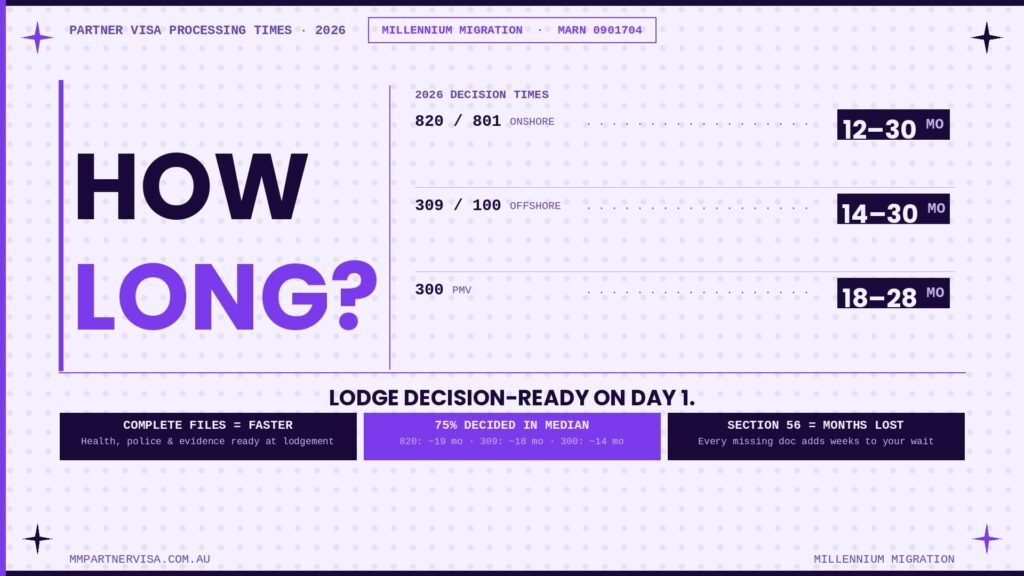
If you’re applying for an Australian partner visa, the wait is real. Partner visa processing times in 2026 sit between 14 and 26 months for the temporary stage alone. Furthermore, the full journey to permanent residency typically takes 3 to 4 years. Navigating these complex requirements can feel overwhelming. Therefore, understanding what those numbers actually mean is vital to prepare for your wait.


Key takeaways
- Partner visa processing times in 2026: 50% of 820 cases finalised within 16 months; 50% of 309 cases within 14 months.
- The permanent stage (801 or 100) is typically assessed ~2 years after the original lodgement date.
- Full lodgement-to-PR journey: usually 3 to 4 years total.
- Long-term couples (3+ years together at lodgement) or couples with children can sometimes get both stages granted at once.
- Being decision-ready at lodgement is the single biggest factor under your control.
In this guide
- 1. Current Partner Visa Processing Times in 2026
- 2. How the Department Publishes These Numbers
- 3. Two Stages, Two Waits — How It Works
- 4. The Full Lodgement-to-PR Timeline
- 5. What Affects Your Partner Visa Processing Times
- 6. When Both Stages Can Be Granted at Once (Double Grant)
- 7. What to Do During the Wait
- 8. If Your Case is Taking Too Long
1. Current Partner Visa Processing Times in 2026
Based on the latest Department of Home Affairs data, here’s where each partner visa subclass currently sits:
| Subclass | 50% decided within | 90% decided within |
|---|---|---|
| Subclass 820 (Onshore temporary) | ~16 months | ~24 months |
| Subclass 801 (Onshore permanent) | ~8 months | ~26 months |
| Subclass 309 (Offshore provisional) | ~14 months | ~24–26 months |
| Subclass 100 (Offshore permanent) | ~10 months | ~24 months |
| Subclass 300 (Prospective Marriage) | ~11–16 months | ~17–23 months |
So if you’re applying onshore, expect your 820 to take around 16 months on average. Offshore applicants typically wait around 14 months for the 309. However, these are medians — half of applicants wait longer.
Source: Department of Home Affairs — Visa processing times (updated monthly)
2. How the Department Publishes These Numbers
They’re Historical, Not Predictions
The Department publishes historical decision data. Consequently, when they say “50% within 16 months,” they mean half of recently decided applications were finalised within that time. Your individual application may be faster or slower than the median.
Why Gaps Occur
Two applications lodged on the same day can have very different outcomes. As a result, comparing your case to a friend’s rarely helps. The variables include decision-readiness, evidence quality, country of origin, complexity of relationship history, and even which case officer reviews the file.
The Numbers Update Monthly
The Department updates processing time data every month. Therefore, always check the most recent figures rather than relying on older estimates. This tracking is especially vital if you read this article more than a few months after publication.
3. Two Stages, Two Waits — How It Works
The partner visa system has a quirk that catches new applicants off guard. Ultimately, there isn’t one decision — there are two. So partner visa processing times need to be understood at both distinct stages.
Stage 1: The Temporary Visa (820 or 309)
You lodge one combined application but it’s assessed in two parts. The first assessment grants the temporary visa — either the 820 onshore or the 309 offshore. This is the wait most people focus on.
Stage 2: The Permanent Visa (801 or 100)
About two years after your original lodgement date, the Department assesses the permanent stage. By then, you’ve usually been in Australia on the temporary visa for months or years. The 801 or 100 grant is the moment you become a permanent resident. Consequently, understanding the structural progression from a subclass 820 vs 801 dynamic can drastically reduce anxiety during the first phase.
Note: The 2-year clock for the permanent stage runs from your original lodgement date, not from when the temporary visa was granted. So if your 820 takes 18 months to grant, you only wait another 6 months before the 801 becomes assessable.
4. The Full Lodgement-to-PR Timeline
Here’s what the journey looks like in months for a typical onshore applicant in 2026:
You lodge the combined 820/801 application. You receive a Bridging Visa A and can stay lawfully.
Temporary visa decided. Most cases finalised by month 16. You’re now on the 820.
Permanent stage opens. Home Affairs requests updated evidence.
Permanent residency is approved. You can now apply for citizenship after meeting residence requirements.
The full lodgement-to-PR journey usually takes 3 to 4 years. Meanwhile, decision-ready applications can finish closer to 3 years. Conversely, cases with unexpected delays often run significantly longer. For offshore applicants, tracking the corresponding subclass 309 vs 100 timeline follows a highly similar multi-year benchmark trajectory.
5. What Affects Your Partner Visa Processing Times
Several critical factors push your case toward the faster or slower end of the range:
- Decision-Readiness at Lodgement: This is the single biggest factor under your control. Decision-ready applications get prioritised. Cases with missing evidence or pending health checks sit at the back of the queue. For details, see our comprehensive decision-ready guide.
- Evidence Quality: Strong, consistent evidence across the financial, household, social, and commitment pillars speeds things up. Weak evidence triggers Section 56 requests — each one adds 3–6 months. Furthermore, staying updated through the overarching Australian partner visa framework gives you a significant clarity advantage.
- Country of Origin: Some countries have additional verification processes due to higher risk matrices. This can cause applications to take longer regardless of preparation.
- Health and Character Checks: Anything flagged for further review (existing medical conditions or background complexities) adds processing time for manual investigation.
6. When Both Stages Can Be Granted at Once (Double Grant)
For some couples, the temporary and permanent stages can be assessed and granted together — bypassing the 2-year wait between stages.
Who Qualifies for a Combined Grant
- Couples who have been in a de facto relationship or married for 3+ years at the time of lodgement, OR
- Couples who have been together for 2+ years AND have a dependent child together.
How It Works in Practice
If you qualify, the case officer may assess both stages at once when they reach your file. Consequently, if your 820/309 takes 14 months, your 801/100 may be granted on the exact same day. In 2026, the Department strictly enforces documentation standards alongside updated baseline processing fees (e.g., AUD $9,365+ fees), meaning mistakes can prove costly.
Note: It’s completely at the discretion of the department to do double grants.
7. What to Do During the Wait
- Keep Building Evidence: Continue building your relationship file — new joint accounts, updated bills, fresh photos, and travel receipts. The 801/100 stage needs evidence from after lodgement.
- Notify Home Affairs of Changes: Address changes, employer changes, marriages, or births must be reported through ImmiAccount within 14 days.
- Check Your Bridging Visa Conditions: Onshore applicants on a Bridging Visa A can stay and work, but cannot leave Australia without a Bridging Visa B (BVB). Therefore, apply for the BVB before booking flights.
8. If Your Case is Taking Too Long

If you are sitting past the 90% processing threshold (24+ months) and haven’t heard anything, check your options:
Check ImmiAccount Messages
Missed Section 56 requests are a primary cause of “stuck” applications. Therefore, check your dashboard directly as email alerts sometimes fail.
Status Enquiry
You can submit an official status enquiry webform once your application has exceeded the published 90th percentile timeline. This tracking action can occasionally prompt file activity.
Do Not Panic Early
Sitting at month 18 with no contact from the Department is uncomfortable but entirely normal in 2026. Only consider escalation avenues if you have safely cleared the 90th percentile timeline.
About the author
Sam is the founder of Millennium Migration. Based in Melbourne, Sam assists clients across Australia with partner, family and complex migration matters.
Related reading
Sources
- Department of Home Affairs — Visa processing times (updated monthly)
- Department of Home Affairs — Partner visa overview (onshore)
- Department of Home Affairs — Partner visa overview (offshore)
- Migration Act 1958 (Cth) — Section 56 (requests for information)
This article provides general information only and is current as of May 2026. It does not constitute personal migration advice. Australian migration law changes frequently — verify current requirements at immi.homeaffairs.gov.au. For advice on your specific situation, contact Sam at Millennium Migration directly.