
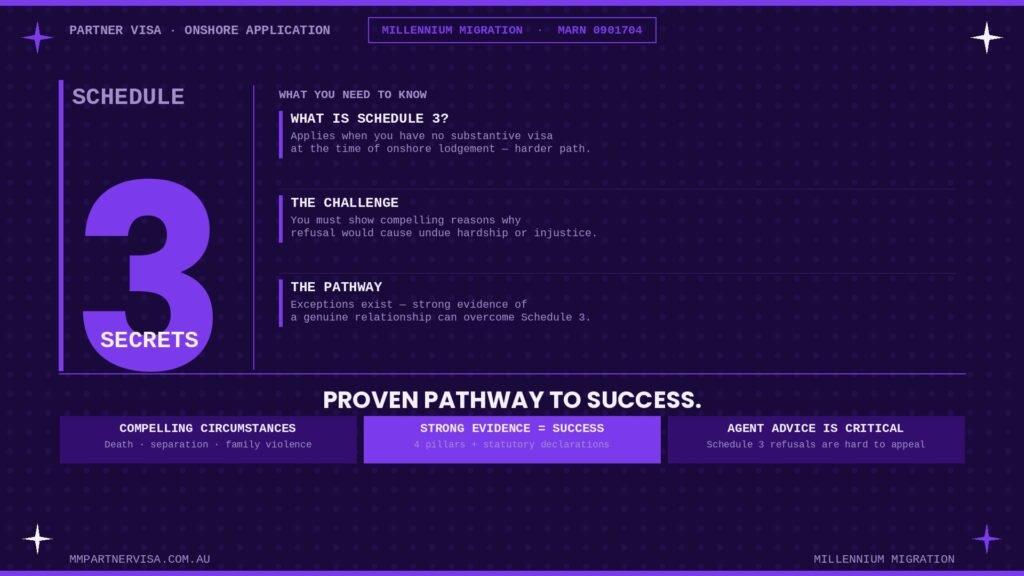
If you’re an onshore partner visa applicant without a current substantive visa, Schedule 3 is the legal hurdle standing between you and your application.
Therefore, understanding clauses 3001 to 3004—and the waiver process—can be the difference between a granted visa and a $9,365 refusal. Here is the plain-English breakdown for 2026.

Key takeaways
- Schedule 3 partner visa rules apply to onshore applicants who don’t hold a substantive visa at the time of lodgment.
- Four clauses exist (3001–3004), but most partner visa cases turn strictly on 3001, 3003, and 3004.
- Clause 3001 dictates a strict 28-day window from the date your last substantive visa expired.
- If you cannot meet the baseline clauses, you must successfully request a “compelling reasons” waiver.
- Always seek professional advice.
In this guide
- What Is Schedule 3 in Plain English?
- Who Schedule 3 Applies To
- Clause 3001 — The 28-Day Rule
- Clause 3002 — The 12-Month Rule
- Clause 3003 — Pre-1994 Unlawful Entrants
- Clause 3004 — The Main Partner Visa Clause
- The Compelling Reasons Waiver
- What Counts as “Compelling Reasons”?
- Strategy: Satisfy vs Waive
1. What Is Schedule 3 in Plain English?
Schedule 3 of the Migration Regulations 1994 is a set of additional criteria for individuals applying for certain visas onshore when they lack a substantive visa. Meanwhile, navigating this process requires precise attention to legislative dates.
A substantive visa is any standard, valid visa with full residency rights—such as a student, work, or tourist visa.
Bridging visas, criminal justice visas, and “unlawful non-citizen” status do not count as substantive.
The schedule 3 partner visa requirement exists because the Department aims to discourage people from letting their visas lapse and using a partner visa application solely to regularise their residency status.
Consequently, anyone without a substantive visa who wishes to lodge an onshore Subclass 820 must either satisfy Schedule 3 or successfully secure a waiver. Understanding how this fits within the broader Australian partner visa framework gives you a significant clarity advantage.
*Note: Schedule 3 does not apply if you hold a current substantive visa (even one expiring soon) or if you apply offshore for a Subclass 309.*
2. Who Schedule 3 Applies To
You are impacted by Schedule 3 rules if all three of the following conditions are true:
- You are applying for an onshore partner visa (subclass 820/801).
- You are physically located in Australia at the time of your lodgement.
- You do not hold a substantive visa on the day you apply.
Common scenarios where Schedule 3 triggers:
- Your student or work visa expired and you did not depart Australia.
- You overstayed the duration of a tourist visa.
- You entered Australia unlawfully or had your previous substantive visa cancelled.
- You are currently holding a Bridging Visa E (BVE) after becoming unlawful.
Therefore, recognizing your position early helps in deciding whether an onshore pathway or an onshore vs offshore partner visa pathway serves your long-term goals better.

3. Clause 3001 — The 28-Day Rule
The rule comes from Regulation 2.03A of the Migration Regulations 1994. It states that a de facto partner visa applicant must have been in a de facto relationship with their sponsor for at least 12 months immediately before the application is lodged.
How it works: If your tourist visa expired on 1 March, you have until 29 March (exactly 28 days later) to lodge your partner visa. If you lodge on day 28, you satisfy clause 3001. If you lodge on day 29, you fail it automatically—there is no grey area or administrative tolerance. Because most people only explore a partner visa months after their status lapses, clause 3001 usually fails, pushing the case into the waiver pathway.
Furthermore, failure to clear this timeline shifts the entire evaluation structure. Applicants often confuse this temporary milestone with the transition mechanics covered in a separate subclass 820 vs 801 pathway breakdown.
*Critical Warning: If your substantive visa expired less than 28 days ago, you must lodge immediately. After day 28, you lose the option to satisfy 3001 and must rely entirely on a waiver.*
4. Clause 3002 — The 12-Month Rule
Clause 3002 operates similarly to 3001 but provides a 12-month deadline instead of 28 days. However, it applies only to a very narrow pool of applicants—specifically those who previously held a Subclass 995 Diplomatic visa or a qualifying special purpose visa. For standard partner visa applicants, clause 3002 is not a relevant pathway.
5. Clause 3003 — Pre-1994 Unlawful Entrants
Clause 3003 is an older legacy clause that applies strictly to individuals who entered Australia unlawfully or whose lawful status lapsed before 1 September 1994.
If you arrived or became unlawful after 1994, this clause does not apply to your matter.
6. Clause 3004 — The Main Partner Visa Clause
For the vast majority of onshore partner visa applicants navigating Schedule 3, clause 3004 is the critical hurdle. It applies to anyone who ceased holding a substantive visa after 1 September 1994.
Section 5CB of the Migration Act 1958 defines a de facto relationship by four tests. All four must be met:
- Factors beyond your control: You must prove that losing your substantive visa status occurred due to factors you could not reasonably influence.
- Compelling reasons: You must establish that compelling reasons exist for granting the partner visa onshore.
- Retrospective eligibility: You must show you would have qualified for a visa at an earlier point before becoming unlawful.
- Future compliance: You must demonstrate a clear intention to comply with all future visa conditions.
*Note: Failure on any single element results in an application refusal, even if you meet the other three perfectly. In 2026, the Department strictly enforces documentation standards alongside updated baseline processing fees (e.g., AUD $9,365+ fees), meaning mistakes can prove costly.*
7. The Compelling Reasons Waiver
If you cannot satisfy clauses 3001 or 3004 directly, your only path forward is to request a compelling reasons waiver. The migration regulations permit a case officer to waive Schedule 3 requirements completely if genuine, compelling reasons are presented.
The Waensila Landmark Decision: In Waensila v Minister for Immigration and Border Protection (2016), the Full Federal Court ruled that the Department must consider all of an applicant’s circumstances up to the date of the decision, rather than just the factors present at lodgement. Consequently, significant relationship milestones, pregnancies, or health changes that develop after you submit your application can legally be used to support your waiver case. Ensuring your overall evidence profile is thoroughly structured according to our decision-ready guide benchmarks remains essential during this period.
8. What Counts as “Compelling Reasons”?
Evaluating Waiver Claim Categories
Because the term is not strictly defined in migration legislation, case officers evaluate claims contextually.
Strong compelling factors:
- Australian Children: Having a biological or adopted child together who is an Australian citizen or PR, especially where separation impacts the child’s welfare.
- Sponsor Hardship: Proof that your Australian partner would suffer severe financial, physical, or psychological hardship if you were forced to leave.
- Serious Health Issues: Severe medical conditions affecting either partner that require ongoing local care.
- Family Violence: Documented instances of domestic abuse or family violence considerations.
Weak factors (generally insufficient on their own):
- The basic financial cost of a plane ticket or temporary relocation.
- Standard emotional distress caused by normal visa processing separation.
- Your current employment or length of residency in Australia without separate hardship factors.
9. Strategy: Satisfy vs Waive
Every Schedule 3 matter requires a clear upfront strategy:
- Focus on Satisfying: Do this only if you are strictly within your 28-day post-expiry window (Clause 3001) or if your visa loss was entirely automated and outside your control.
- Focus on the Waiver: Do this if you have missed the 28-day deadline but possess powerful equity factors, such as an Australian child, an established long-term dependency relationship, or severe medical hardships.
Because satisfying clause 3004’s multi-limb criteria is very difficult, we help our clients always build Schedule 3 submissions directly around the compelling reasons waiver pathway to maximise the chance of an onshore approval. Obviously, there have to be grounds that can be proven.
Take the free 2-minute quiz to see where you stand — or download the free Notion checklist to build your evidence package.
Related reading
About the author
Sam is the founder of Millennium Migration, based in Melbourne. He assists clients across Australia with high-risk and complex partner visa cases, including Schedule 3 submissions and ART reviews.
Sources
- Migration Regulations 1994 (Cth) — Schedule 3, clauses 3001, 3002, 3003, 3004
- Waensila v Minister for Immigration and Border Protection [2016] FCAFC 32
- Department of Home Affairs — Partner visa (onshore) overview
This article provides general information only and is current as of May 2026. It does not constitute personal migration advice. Schedule 3 matters are legally complex; always verify current requirements with a Registered Migration Agent.