
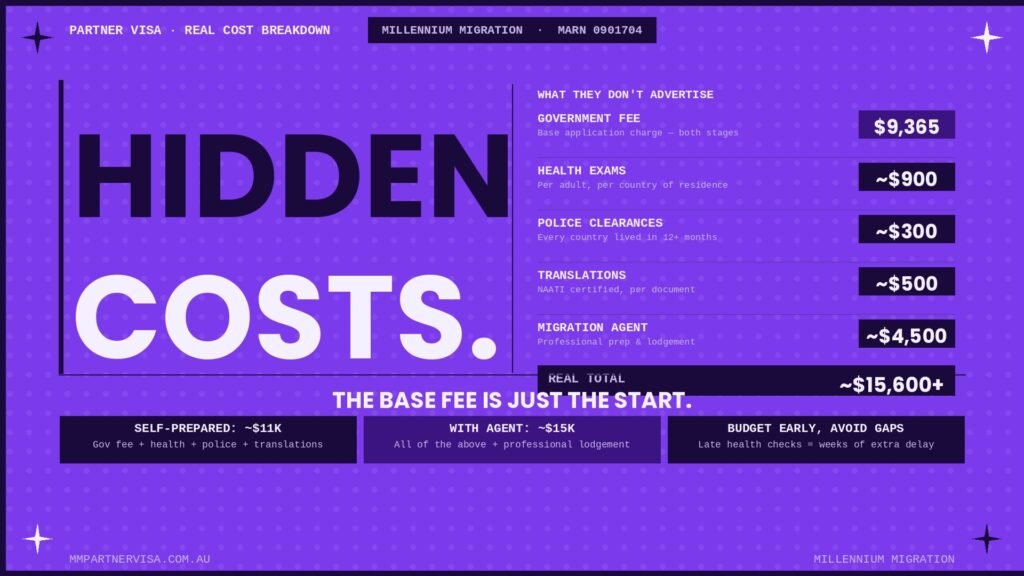
Most couples planning an Australian partner visa know about the $9,365 application fee. However, the hidden costs of a partner visa can add another $3,000 to $15,000 to your total spend — depending on your situation. Therefore, planning for these outlays is essential. Here’s exactly what to budget for in 2026.
Key takeaways
- The hidden costs of a partner visa typically add $3,000–$15,000 on top of the $9,365 base fee.
- Largest hidden costs: health examinations, police checks, NAATI translations, certified copies.
- Add 1% to all government fees as a Visa Application Charge surcharge applies for online credit card payments.
- Additional applicants (children, dependents) cost extra — $2,345 per child under 18, $4,685 per dependent 18+.
- Migration agent fees range from $3,500 to $6,500+ for standard cases.
- Budget for the journey — not just the lodgement day.
In this guide
- The headline fee — what’s included
- Health examinations: $400–$800 per person
- Police checks: $50–$200 per country
- NAATI translations: $40–$120 per document
- Additional applicants (children, dependents)
- Migration agent fees: $3,500–$6,500+
- The surprise costs no one tells you about
- Total realistic budget for 2026
- Where you can legitimately save money
- Frequently asked questions
1. The headline fee — what’s included
The base partner visa application charge for 2025–26 is $9,365. This covers the primary applicant for the combined 820/801 (onshore) or 309/100 (offshore) application. So one fee covers both the temporary and permanent stages.
What the $9,365 actually pays for
- Processing of the combined temporary and permanent partner visa application
- The temporary 820 or 309 visa decision
- The permanent 801 or 100 visa decision (around 2 years after lodgement)
- Administrative work by the Department of Home Affairs
What it doesn’t cover
Everything else listed below. So the $9,365 is just the starting point — and the headline costs that follow it are the reason most couples blow their budget.
2026 update: Government fees are indexed annually. So the base charge typically increases by 1–3% each July. If you’re planning to lodge after July 2026, budget for a small increase.
2. Health examinations: $400–$800 per person
Every partner visa applicant must complete a medical examination. So this is unavoidable.
Standard health check (Australia)
Through Bupa Medical Visa Services, the standard package typically costs:
- Medical examination by an approved doctor: ~$300–$400
- Chest X-ray (for applicants 11+ years): ~$150–$250
- HIV blood test (for applicants 15+ years): ~$80–$150
- Hepatitis B/C tests if required: ~$80–$150
So expect around $500–$700 per adult applicant. Children typically pay less since fewer tests are required.
Offshore applicants
Costs vary by country and panel doctor. Some countries are cheaper (parts of Asia, India). Others are more expensive (UK, US, Western Europe). However, you still need the same medical components.
If a health condition needs follow-up
Any flagged condition (pregnancy, prior tuberculosis, chronic conditions) can require additional specialist reports — often $200–$1,000+ each. So budget extra if you have any existing health conditions.

3. Police checks: $50–$200 per country
You need a police clearance from every country where you’ve lived 12+ months in the last 10 years. So the cost depends entirely on how mobile you’ve been.
Common police check costs in 2026
| Country | Approximate cost | Processing time |
|---|---|---|
| Australia (AFP) | $56 | 5–15 days |
| UK (ACRO) | £55 (~$110) | 10–15 days |
| India | ₹500–2,000 + fees (~$50–100) | 4–6 weeks |
| USA (FBI) | $18 USD + processing (~$50) | 4–8 weeks |
| Other (varies) | $50–$200+ | 3–12 weeks |
For an Australian applicant who’s lived in 2 countries, expect $150–$300 total. Furthermore, for applicants with more complex travel histories, tracking these outlays is vital as costs can reach $500+.
4. NAATI translations: $40–$120 per document
Any non-English document submitted to the Department needs a NAATI-certified translation. Consequently, this represents a major hidden fee pathway for applicants whose original certificates aren’t in English.
What typically needs translation
- Birth certificates (applicant and any children)
- Marriage certificates (if applicable)
- Divorce certificates from prior marriages
- Police clearance certificates
- Educational qualifications (if relied on)
- Sometimes bank statements or financial documents
Typical costs
- Standard one-page document: $40–$80
- Multi-page documents (e.g. police checks with full text): $80–$150
- Rush turnaround (24–48 hours): add 50–100% premium
So if you have 5–8 documents to translate, expect $300–$800 total. Some couples spend more — particularly those from countries with extensive bureaucratic paperwork.
5. Additional applicants (children, dependents)
Including children or other dependents in your partner visa application adds significant cost.
| Additional applicant | 2025–26 fee |
|---|---|
| Child under 18 | $2,345 |
| Dependent 18 or older | $4,685 |
| Plus second instalment (each) | Same again at PR grant |
So a family with 2 children under 18 adds ~$4,690 to the base fee. Plus their separate health checks and police clearances. As a result, partner visa applications with children are significantly more expensive overall.
6. Migration agent fees: $3,500–$6,500+
Many couples handle their partner visa applications themselves to save money. However, the complexity of the case often justifies professional help.
Typical fee ranges
- Standard case (married, simple history): $3,500–$5,000
- De facto case (more evidence work): $4,000–$6,000
- Complex case (Schedule 3, prior refusals, character issues): $6,000–$10,000+
- AAT review (after refusal): $5,000–$15,000+ depending on complexity
What you should get for the fee
- Initial case assessment and strategy
- Evidence review and gap identification
- Form preparation and lodgement support
- Submissions addressing legal requirements
- Communication with the Department during processing
- Response to any Section 56 requests
For a transparent fee structure on your specific case, contact Millennium Migration. Sam provides fixed-fee quotes upfront so you know exactly what you’re paying for.
7. The surprise costs no one tells you about

These are the costs that don’t appear on most “how much does a partner visa cost” articles — but show up in real life.
Credit card surcharge
Paying the visa fee online by credit card adds a 1% surcharge. So on a $9,365 application, that’s another $94 just to pay the Department.
Relationship registration fees
If you register your relationship to skip the 12-month de facto rule, expect $200–$300 in state government fees.
Certified copies and notarisation
Some documents need certified copies or notarised translations. So expect $20–$50 per document, particularly for offshore applications going through embassies.
Travel costs
Offshore applicants may need to travel to attend interviews at consulates. Onshore couples on bridging visas applying for BVB to travel pay a separate $185 fee.
Postage and document fees
Sending certified documents internationally adds up. Tracked international post for important documents can cost $30–$50 per package.
If you need to redo health or police checks
Both expire after 12 months. So if your processing takes longer than expected, you may need to redo them — adding another $500–$1,000 to your spend. Reviewing historical timelines via our partner visa processing times guide helps you optimize this scheduling.
Refusal and AAT appeal fees
If your application is refused, the Administrative Review Tribunal (ART) review fee is significant. Plus new agent fees apply. Therefore, a refused application can effectively cost the original $9,365 plus another $5,000–$15,000 to fix. This risk is why working with Millennium Migration at lodgement matters more than saving fees upfront. For high-risk matters, checking our Schedule 3 partner visa guide helps you assess complex threshold exposures upfront.
8. Total realistic budget for 2026
Putting it all together, here’s a realistic budget range for a typical couple in 2026:
| Cost item | DIY (couple alone) | With migration agent |
|---|---|---|
| Application fee | $9,365 | $9,365 |
| Health examinations (2 adults) | $800–$1,200 | $800–$1,200 |
| Police checks (2 people, 2 countries) | $200–$400 | $200–$400 |
| NAATI translations | $300–$800 | $300–$800 |
| Migration agent fees | $0 | $3,500–$6,500 |
| Misc (surcharges, post, copies) | $200–$400 | $200–$400 |
| TOTAL (typical case) | $10,865–$12,165 | $14,365–$18,665 |
So even a “simple” partner visa application costs around $11,000 minimum with no professional help. Complex cases, families with children, or applicants from multiple countries can easily exceed $20,000+. To manage your documentation preparation effectively before triggering fees, tracking your requirements inside our structured decision-ready guide prevents expensive administrative re-work.
9. Where you can legitimately save money
Pay by BPAY instead of credit card
BPAY avoids the 1% surcharge. So that’s $94 saved on the base fee.
Batch your translations
Many NAATI translators offer bulk discounts. So submitting 5–8 documents together typically costs less than translating them one by one over months.
Time your health checks carefully
Health checks expire after 12 months. So if you complete them too early and processing extends, you’ll need to redo them. Timing them right after lodgement (rather than before) maximises validity.
Get police checks before they become urgent
Many couples pay rush fees on police checks because they’re up against deadlines. So starting police checks 2 months before lodgement avoids premium pricing.
Invest in getting it right the first time
The biggest “saving” is avoiding refusal. Spending $3,500–$6,500 on professional help with Millennium Migration upfront is far cheaper than a refused application that costs the full $9,365 plus appeal fees plus re-application costs. Reviewing your situation through the comprehensive Australian partner visa framework provides an exhaustive roadmap of these structural gates.
One area NOT to cut corners: NAATI translations. Some couples try to translate documents themselves or use unaccredited translators. The Department only accepts NAATI-certified translations. So saving $80 here can mean a Section 56 request and 3-6 months of additional processing time.
10. Frequently asked questions
Can I pay the partner visa fee in instalments?
No. The full $9,365 must be paid at lodgement. So the Department doesn’t offer payment plans. Some couples use a credit card to spread the cost — but that incurs the 1% surcharge plus your credit card interest.
Is the partner visa fee refundable if I’m refused?
No, the application charge is non-refundable. So if your application is refused, you lose the full $9,365 plus all other costs. This is why working with Millennium Migration to ensure decision-readiness before lodgement is the best protection.
Do I have to pay a second fee for the 801 (permanent visa)?
No. The $9,365 covers both the temporary (820) and permanent (801) stages. So you pay once at lodgement and don’t pay again when transitioning to PR. The same applies for the 309/100 pathway.
Are migration agent fees tax-deductible?
Generally not for private partner visa applications. However, if the visa is required for employment-related reasons, some costs may be deductible. Speak to an accountant about your specific situation.
What’s the cheapest pathway to PR through marriage?
All partner visa subclasses (820/801, 309/100, 300) cost the same — $9,365 base fee. So there’s no cheaper pathway through marriage. Other PR pathways exist (skilled migration, employer sponsorship) but those aren’t dependent on marriage.
Can I get a discount on the partner visa fee?
In limited cases, yes. People holding certain other visas (specifically those who held a Prospective Marriage Visa subclass 300 within the last 12 months) pay a reduced fee of $1,560 instead of $9,365. So check with Millennium Migration whether your situation qualifies for a reduced fee.
Are there hidden costs after the visa is granted?
Some, yes. Citizenship application later incurs a government fee. Renewing health checks or police checks if you travel may apply. Plus regular adult expenses like Medicare contributions, tax obligations, and superannuation that come with permanent residency.
What if I can’t afford the full cost upfront?
Some couples save for 6–12 months before lodging. Others use credit, family support, or part-payment arrangements with migration agents. Contact Millennium Migration to discuss your specific situation — Sam may offer payment plans for agent fees.
Will fees increase in July 2026?
Government visa fees are typically indexed annually on 1 July. So expect a 1–3% increase. Lodging before 1 July 2026 locks in the current fee. After that, the base charge will likely exceed $9,500.
Is it worth paying for a migration agent vs DIY?
For straightforward cases (married couple, simple history, clear evidence), DIY is feasible. However, for any complexity — Schedule 3, prior refusals, character issues, complex relationship history — the cost of professional help from Millennium Migration is typically far less than the cost of a refused application. Take the free quiz to assess where your case sits.
Take the free 2-minute quiz to map out your specific situation — or download the free Notion checklist to plan your evidence package.
Related reading
About the author
Sam is the founder of Millennium Migration, based in Melbourne. He provides transparent, fixed-fee partner visa services across Australia.
Sources
- Department of Home Affairs — Partner visa application charges
- Bupa Medical Visa Services — health examination pricing
- Australian Federal Police — National Police Check costs
- NAATI — Translator directory and typical pricing
This article provides general information only and is current as of May 2026. Government fees and third-party costs change frequently — verify current pricing at immi.homeaffairs.gov.au. For a transparent fee estimate on your specific situation, take our quiz or contact Sam at Millennium Migration directly.