
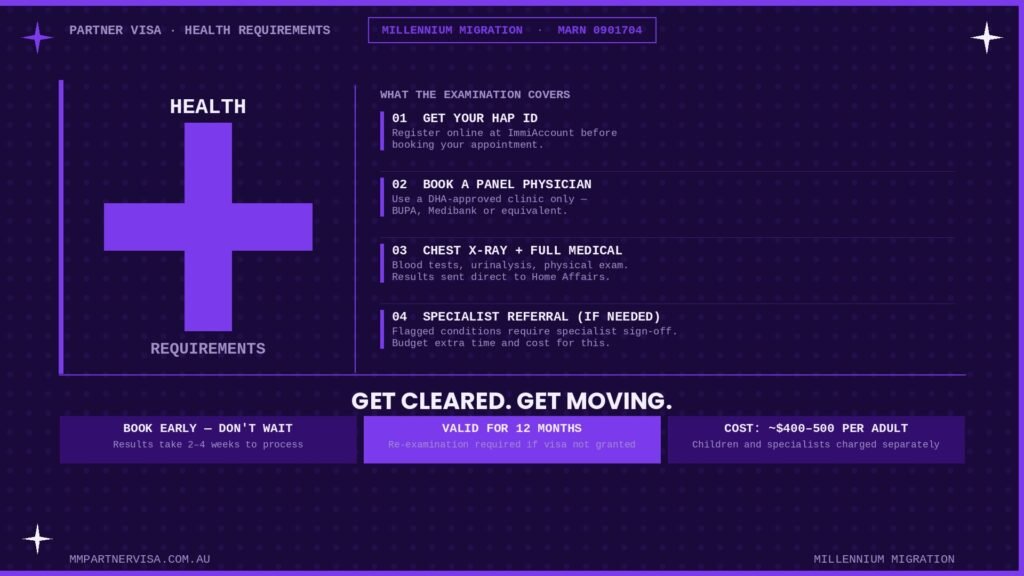
Every partner visa applicant must meet Australian partner visa health requirements. So even if your application is otherwise perfect, failing the medical can derail the entire process. Furthermore, navigating these medical criteria can feel incredibly daunting. Here’s exactly what to expect, what tests are required, and what happens if a health issue is flagged.

Key takeaways
- All partner visa applicants must meet partner visa health requirements — assessed to the permanent standard even at the temporary visa stage.
- You need a HAP ID before booking — issued through ImmiAccount after lodgement, or via the My Health Declarations service before lodging.
- In Australia, exams go through Bupa Medical Visa Services. Offshore, through approved panel physicians.
- Standard tests: medical exam (all ages), chest X-ray (11+), HIV and serum creatinine (15+), Hep B if from a high-risk country.
- Results are valid for 12 months. Health undertakings, if required, are valid for 6 months.
- Pre-existing conditions don’t automatically fail you — but they can require a health waiver assessment.
In this guide
- Why partner visas require health checks
- The permanent standard — even at Stage 1
- The standard tests by age
- Getting your HAP ID
- Booking your medical examination
- What happens at the appointment
- Health examination costs
- When to do your medical examination
- What if you have a health condition
- Health waivers for partner visas
- Frequently asked questions
1. Why partner visas require health checks
Australian migration law sets minimum public health standards for all visa applicants. So the partner visa health requirements exist to protect public health, ensure applicants don’t pose disease transmission risks, and assess the likely cost burden on Australia’s healthcare system.
The Department of Home Affairs doesn’t judge applicants based on personal health. However, conditions that would impose significant healthcare costs or risks may trigger additional assessment — and in some cases, refusal without a health waiver.
Important: Health concerns rarely cause refusal in straightforward partner visa cases. So most applicants — even those with manageable health conditions — pass without issue. The cases that need careful handling involve specific conditions like HIV, hepatitis, tuberculosis, severe chronic illnesses, or conditions requiring expensive ongoing treatment.
2. The permanent standard — even at Stage 1
Here’s a critical detail many applicants miss about the partner visa health requirements: applicants are assessed to the permanent visa health standard at Stage 1 — not the temporary standard. So even when you’re applying for the 820 (which is technically a temporary visa), your health examination uses the higher permanent residence standard.
Why this matters
The permanent standard considers long-term healthcare costs. Consequently, a condition that might be fine for a short-stay tourist could be flagged for a partner visa applicant. The Department’s reasoning: you’ll likely be in Australia for life, so the assessment must account for decades of potential healthcare use.
Practical implication
You only do health checks once for the 820/801 combined application. As a result, you don’t need to redo them for the permanent stage — provided the original results are still valid when the 801 is assessed. Reviewing the overarching architectural framework within our foundational Australian partner visa framework helps you ground this long-term progression sequence perfectly.
3. The standard tests by age
The partner visa health requirements tests required depend on your age. Here’s the standard breakdown for partner visa applicants:
| Test | Required for |
|---|---|
| Medical examination | All ages |
| Chest X-ray | Age 11 and older |
| HIV blood test | Age 15 and older |
| Serum creatinine / eGFR | Age 15 and older |
| Hepatitis B test | If from a high-risk country |
Additional tests if flagged
The Department may require additional tests in some cases:
- Hepatitis C testing
- Sputum tests if TB is suspected
- Cardiac assessments for cardiovascular conditions
- Mental health assessments in specific situations
- Specialist reports for any chronic conditions disclosed
4. Getting your HAP ID
The HAP ID (Health Assessment Portal ID) is a unique identifier linking your medical results to your visa file. So you can’t book the medical exam without one.
Two ways to get a HAP ID
Option 1: After lodgement
Once you’ve lodged your partner visa application, log into ImmiAccount, complete the “Organise Health Examinations” digital form, and download the PDF referral letter containing your HAP ID. So this happens naturally as part of post-lodgement steps.
Option 2: Before lodgement (My Health Declarations)
You can get a HAP ID before lodging by using the My Health Declarations service. Then you complete medicals first, lodge afterward, and your results are already on file. As a result, your application starts as decision-ready on the health front. For a deeper understanding of front-loading evidence, reviewing our comprehensive decision-ready guide helps optimize this layout sequencing smoothly.
Which approach is better?
The pre-lodgement approach (My Health Declarations) is generally preferred because:
- Your application is fully decision-ready from day one
- Any health issues are identified before you pay $9,365 in application fees
- The 12-month validity clock doesn’t start ticking through processing delays
Therefore, managing this checklist properly keeps your file clear of unexpected hold queues. However, for couples close to a critical deadline, lodge first and do medicals immediately after.
5. Booking your medical examination
In Australia
All medical exams for Australian visas are conducted through Bupa Medical Visa Services. Two ways to book:
- Online: bupamedicalvisaservices.com.au
- Phone: 1300 794 919
Bupa has dedicated medical assessment centres in all capital cities plus partner clinics in regional areas. So most applicants can find a location within reasonable distance.
Outside Australia
You must attend an approved panel physician. Therefore, search the Department’s panel physician finder for clinics in your country. Each country has designated panel clinics — non-approved doctors cannot complete the assessment.
What to bring
- Your passport (original, not a copy)
- HAP ID referral letter
- Prescription glasses or contact lenses if you wear them
- Any specialist reports for chronic conditions
- List of current medications
- Vaccination records (especially for children)
6. What happens at the appointment
The full appointment usually takes 30 to 90 minutes depending on which tests you need. Here’s what happens:
Medical history review
You’ll complete a detailed health questionnaire covering past and current conditions, medications, surgeries, hospitalisations, and family history. So answer honestly — the Department cross-references this with your file.
Physical examination
A general health check including height, weight, blood pressure, vision check, and physical examination by the doctor. Standard stuff.
Chest X-ray (if required)
A standard chest X-ray to screen for tuberculosis. The radiographer takes the image, the radiologist reviews it, and results are usually available within days.
Blood tests
For HIV and serum creatinine (if 15+), plus Hepatitis B if from a high-risk country. Standard blood draw — no fasting required.
Results submitted electronically
The clinic submits results directly to the Department through the eMedical system. You don’t need to chase paperwork. So once you complete the exam, the results land on your file automatically.
7. Health examination costs
Costs vary by location and the tests required. Here’s what to budget in 2026:
| Component | Typical cost (Australia) |
|---|---|
| Medical examination | $300–$400 |
| Chest X-ray | $150–$250 |
| HIV blood test | $80–$150 |
| Serum creatinine / eGFR | $30–$80 |
| Hepatitis B (if required) | $80–$150 |
| Typical adult total | $500–$700 |
Costs are paid out of pocket to Bupa or the panel physician — Medicare doesn’t cover visa medical examinations, even if you have private health insurance. Furthermore, navigating these expenses alongside translation outlays requires a transparent look at your total cash flow plan, which you can map out via our hidden costs of a partner visa ledger breakdown.
Offshore costs
Costs vary significantly by country. Some countries (parts of Asia, India) are cheaper. Others (UK, US, Western Europe) are similar to or higher than Australian costs.
8. When to do your medical examination

Timing matters because results are valid for 12 months. So doing them too early can mean redoing them later if processing extends. Reviewing typical structural case windows via our updated partner visa processing times guide ensures your health check sits perfectly inside active assessment periods.
Strategy 1: Pre-lodgement via My Health Declarations
Best for: standard cases with no time pressure.
- Get HAP ID through My Health Declarations
- Complete medicals
- Lodge application with health results already on file
This maximises the chance your case is decision-ready at lodgement.
Strategy 2: Immediately after lodgement
Best for: applicants up against a deadline (visa expiry, 12-month rule, processing slot).
- Lodge application to lock in the lodgement date
- Get HAP ID through ImmiAccount within days
- Book medicals immediately — ideally within 2 weeks of lodgement
What to avoid
Don’t lodge and then wait months to do medicals. This leaves your case sitting in limbo. The case officer can’t complete assessment without health clearance, so processing stalls indefinitely.
9. What if you have a health condition
Most pre-existing conditions don’t cause refusal under the partner visa health requirements. However, certain conditions trigger additional scrutiny.
Generally not problematic
- Well-managed diabetes
- Stable hypertension on medication
- Past surgeries that have healed
- Common mental health conditions on stable treatment
- Mild asthma
Conditions that may trigger additional assessment
- HIV (especially when treatment costs are projected high)
- Active tuberculosis or recent treatment
- Hepatitis B or C with active liver disease
- Cancer history (depending on type, stage, and treatment status)
- Severe intellectual disability or significant developmental delay
- Conditions requiring expensive ongoing treatment (organ transplants, certain biologics)
- Chronic kidney disease requiring dialysis
Don’t try to hide a condition. The Department’s medical examination is thorough, and lying or omitting information is a serious matter under Public Interest Criterion 4020. Disclose everything honestly — and if you have concerns, contact Millennium Migration before booking your medical. Sam regularly handles cases involving health conditions.
10. Health waivers for partner visas
Partner visas are one of the few visa categories where health waivers are available. So if your health condition would otherwise mean refusal, the Department can waive the requirement in compelling circumstances. For high-risk profiles who are also managing non-substantive status hurdles, checking our standalone Schedule 3 partner visa guide helps map combined threshold exposures cleanly.
When health waivers are considered
The Department considers waivers when:
- The applicant has a partner visa application that’s otherwise well-prepared
- The cost or risk to the Australian community is identified
- There are compelling reasons supporting the grant despite the health issue
What strengthens a health waiver case
- Strong genuine relationship evidence
- Australian citizen children of the relationship
- Sponsor would suffer significant hardship if separated
- The applicant has skills or contributes economically
- Family support is available in Australia
- Private health insurance arrangements to offset healthcare costs
The process
Health waiver applications need a detailed submission addressing the legal test. So this isn’t a DIY exercise — get professional help. In 2026, the Department strictly enforces documentation standards alongside updated baseline processing fees (e.g., AUD $9,365+ fees), meaning mistakes can prove costly. Millennium Migration handles health waiver cases regularly and structures the submission to give applicants the best chance of success.
11. Frequently asked questions
Can I refuse certain tests in the medical examination?
No. All tests required by the Department are mandatory. Refusing a test means the medical examination is incomplete, and the application cannot be assessed. The doctor will explain each test before performing it.
What if I’m pregnant during the medical exam?
Pregnant applicants can still complete most of the examination. However, the chest X-ray is typically deferred until after delivery to avoid radiation exposure. The Department issues a health undertaking, valid for 6 months, requiring you to complete the X-ray after giving birth.
Are HIV-positive applicants automatically refused?
No. HIV status alone doesn’t result in automatic refusal. However, the Department assesses the projected treatment costs. Partner visa applicants can apply for a health waiver if the case meets the threshold for compelling circumstances. Contact Millennium Migration to discuss your specific situation.
Can I use my regular GP for the visa medical?
No. Only doctors authorised by the Department can perform visa medical examinations. In Australia, this means Bupa Medical Visa Services exclusively. Your regular GP cannot complete the assessment.
How long are health examination results valid?
12 months from the date of the examination. So if your application is still processing after 12 months, you may need to redo the medicals. Health undertakings (e.g. for deferred X-rays during pregnancy) are valid for 6 months.
Do my children need health examinations too?
Yes. All applicants included in the partner visa application — including children — must complete the medical examination appropriate for their age. Children under 11 typically only need the basic medical exam, not X-rays or blood tests.
What happens if I fail the health requirement?
For partner visas, failing the health test doesn’t automatically mean refusal. The Department considers a health waiver if compelling circumstances exist. Contact Millennium Migration immediately if you receive a notification about health concerns — early action gives the strongest case.
Can I do my medical exam in a country other than my country of citizenship?
Yes. The medical must be done by an approved panel physician — not in any specific country. So if you’re travelling, you can complete the medical wherever an approved panel physician is located.
Does Medicare cover the partner visa medical?
No. Visa medical examinations are not covered by Medicare, even if you currently hold Medicare access through a bridging visa. The full cost must be paid out of pocket. Private health insurance typically doesn’t cover these either.
Should I complete medicals before or after lodging?
For most cases, pre-lodgement via the My Health Declarations service is preferred. This keeps your application decision-ready from day one and identifies any health concerns before you pay the $9,365 application fee. However, if you’re up against a deadline, lodge first and book the medical within 1-2 weeks.
Take the free 2-minute quiz — or download the free Notion checklist to plan your evidence and lodgement timing.
Related reading
About the author
Sam is the founder of Millennium Migration, based in Melbourne. He handles partner visa cases involving health waivers, complex medical histories, and Schedule 3 matters across Australia.
Sources
- Department of Home Affairs — Arrange your health examinations
- Bupa Medical Visa Services — Visa Medical Assessment booking and pricing
- Migration Act 1958 (Cth) — Public Interest Criterion 4007 (health requirements)
- Department of Home Affairs Procedural Instructions — Health waiver assessment guidelines
This article provides general information only and is current as of May 2026. Health examination requirements may vary based on individual circumstances — verify current requirements at immi.homeaffairs.gov.au. For advice on a partner visa with health considerations, take our quiz or contact Sam at Millennium Migration directly.