
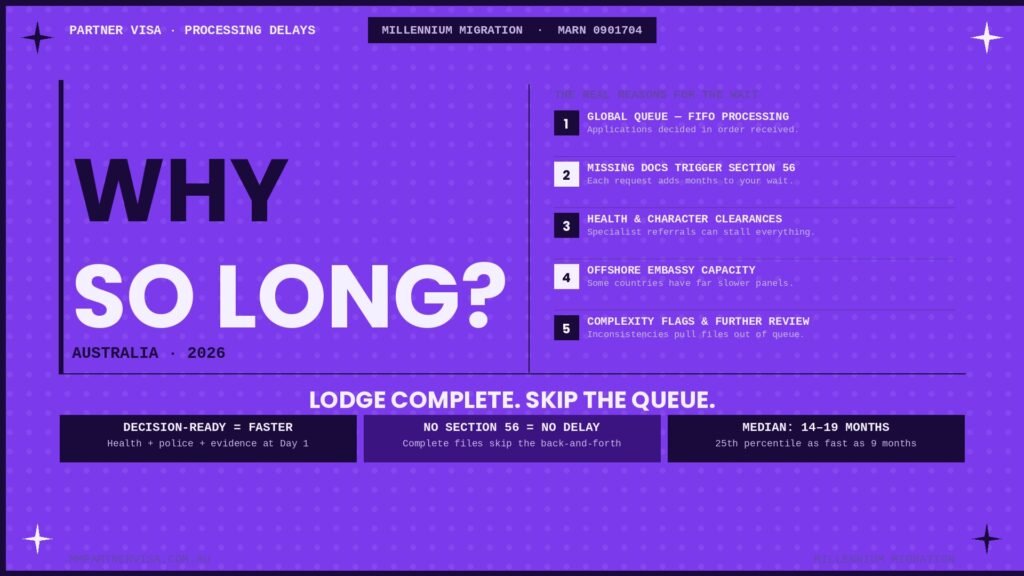
For most couples, the hardest part of the partner visa process isn’t lodging the application — it’s waiting. With partner visa delays regularly stretching to 18-24 months, the question is: why does it take so long? Here are the 10 real reasons in 2026 — and what you can actually do about them.

Key takeaways
- Most partner visa delays come from the case officer queue — applications sit waiting before any active assessment begins.
- The 2025-26 integrity push means tighter document verification, social media cross-checks, and AI-driven validation — adding processing time.
- Health checks, police certificates, and Section 56 requests can each add weeks or months to your timeline.
- Applications with sponsors who have children, complex history, or character issues face additional scrutiny.
- Migration program planning levels cap annual grants, creating queues independent of your case strength.
- Decision-ready applications prepared by Millennium Migration typically face shorter partner visa delays than DIY lodgements.
In this guide
- The headline numbers in 2026
- 1. The case officer queue — the main partner visa delays
- 2. The 2026 integrity push
- 3. Health and police check delays
- 4. Sponsor character verifications
- 5. Section 56 requests pause everything
- 6. Complex case markers that extend partner visa delays
- 7. Country-specific factors
- 8. Migration program planning levels
- 9. Decision-ready vs incomplete applications
- 10. What you can do to minimise partner visa delays
- Frequently asked questions
The headline numbers — partner visa delays in 2026
Before diving into the reasons, here’s what partner visa delays actually look like in 2026:
| Visa subclass | 50% processed in | 90% processed in |
|---|---|---|
| Subclass 820 (onshore temp) | 16 months | 24 months |
| Subclass 309 (offshore temp) | 14 months | 24-26 months |
| Subclass 801 (onshore PR) | 8 months | 26 months |
| Subclass 100 (offshore PR) | 10 months | 21 months |
| Subclass 300 (PMV) | 11-16 months | 17-23 months |
So the typical timeline from lodgement to a granted permanent residency is 2-4 years. Most of that is waiting — not active processing. For the detailed breakdown by subclass, see our 2026 partner visa processing times guide.
1. The case officer queue — the main partner visa delays
The single biggest factor in partner visa delays isn’t case complexity — it’s the queue. Applications sit waiting for case officer allocation long before anyone actively assesses them.
What happens during the queue period
- Your application is logged and assigned a file
- Initial automated checks run (basic validity, fee paid, forms complete)
- The file then sits in the processing queue for the relevant subclass
- When a case officer becomes available with the right expertise and country knowledge, your file is allocated
- Active assessment begins only after allocation
Why the queue is so long
Partner visa applications are one of the largest visa categories in Australia. The number of applications regularly exceeds the Department’s processing capacity. As a result, queues build up — and applications can sit untouched for months before active work begins.
2. The 2026 integrity push
In 2025-26 the Department sharpened its migration-integrity focus, backing it with substantial new funding and a firm decision-ready standard. As a result, processing now includes more verification than ever — adding to the typical partner visa delays.
What’s now actively verified
- Employment claims (cross-referenced with ATO records)
- Bank statements (validated against banking systems)
- Social media presence (matched against the relationship claims)
- Document authenticity (AI-driven verification of certificates, IDs, photos)
- Cross-application consistency (your statements compared with previous visa records)
- Sponsor’s claimed Australian connections
Practical impact
The deeper verification means case officers spend more time per application. Consequently, even straightforward cases take longer than they did in earlier years. This is the new normal — and it’s not slowing down.

3. Health and police check delays
External third-party processes regularly add weeks to your timeline.
Health examination timeline
- Booking with Bupa Medical Visa Services — typically 1-3 weeks for an appointment
- The examination itself — 1-2 hours on the day
- Results submitted via eMedical — typically 1-2 weeks
- If health undertakings are required, additional clearance time applies
- If specialist follow-up reports are needed, add 4-8 weeks
Police check timeline
- Australian AFP check — 5-15 business days
- UK ACRO check — 10-15 business days
- Indian police clearance — 4-6 weeks
- US FBI check — 4-8 weeks
- Other countries — anywhere from 2 weeks to 6 months
For applicants with police checks required from multiple countries, this stack of waiting periods can mean months added to overall partner visa delays. That makes getting these started early — even before lodgement — a key time-saver.
4. Sponsor character verifications
Sponsor character checks are a 2025-26 Department priority — particularly when children are involved in the application.
What this adds to processing time
- AFP police clearance for the sponsor
- State and territory police database checks
- Cross-referencing against family violence orders
- Working with Children clearances (some cases)
- If overseas residence applies — overseas police checks for any country lived in 12+ months since age 16
For sponsors with travel history across multiple countries, this verification stack alone can add 2-3 months. See our sponsor eligibility and obligations guide for the full breakdown.
5. Section 56 requests pause everything
If the case officer needs more information, they’ll send a Section 56 request via ImmiAccount. The clock pauses on active processing until you respond.
How this extends timelines
- Your application moves out of the active queue while awaiting your response
- You typically have 28 days to respond
- Once you respond, your case re-joins the queue — sometimes from the back
- If multiple Section 56 requests occur, each one resets some of the timeline
Common Section 56 triggers
- Missing or expired health checks or police certificates
- Insufficient evidence of one of the four relationship pillars
- Form 888 declarations from non-Australian witnesses
- Inconsistencies between applicant and sponsor statements
- Documents not properly translated by NAATI translators
Most Section 56 triggers are preventable with proper case preparation. Millennium Migration prepares applications to pre-empt these requests — keeping cases moving through the queue without pauses.
6. Complex case markers that extend partner visa delays
Some application features automatically trigger additional scrutiny — and longer processing times.
Complexity markers the Department watches for
- Significant age gap between partners
- Short relationship duration before lodgement
- Previous failed marriages or partner visa applications
- Sponsor with criminal history (even minor)
- Sponsor previously sponsored other partners
- Schedule 3 cases involving compelling reasons arguments
- Stepchildren involved with custody complications
- Health waiver applications
- Cross-cultural marriages without strong shared evidence
- Applicant from a country flagged for higher fraud risk
None of these factors means automatic refusal. Each one simply means more scrutiny — which means more time. Cases with multiple complexity markers can stretch well beyond the published processing times.
7. Country-specific factors
Where the applicant is from significantly affects processing time.
Faster countries
Applicants from low-risk countries with well-documented processes (UK, US, Western Europe, NZ, Canada) typically face shorter timelines because document verification is straightforward and police checks are fast.
Slower countries
Countries with higher fraud markers, complex document systems, or slow third-party authority response times typically face longer waits. This isn’t discriminatory — it reflects the verification time actually required.
Common slower-country factors include:
- Slow overseas police check processing
- Higher rate of document fraud requiring deeper verification
- Limited consular capacity for in-country interviews
- Translation requirements for complex bureaucratic documents
8. Migration program planning levels
Each year, the Australian government sets a planning level for total permanent migration grants. This affects partner visa delays in ways most applicants don’t realise.
How planning levels create queues
- The annual program is split between family and skilled streams
- Within family stream, partner visas have an allocated number of grants per year
- Once that annual allocation approaches, processing of new grants may slow
- Applications accumulate, waiting for the next program year
Why this matters strategically
Cases lodged early in the program year (after 1 July) sometimes face shorter waits than those lodged in May or June, which compete for end-of-year capacity. That creates a strategic angle to lodgement timing.
9. Decision-ready vs incomplete applications

Whether your application arrives decision-ready makes a significant difference to total processing time.
Decision-ready applications
A decision-ready application has all required documents, health checks, police clearances, evidence, and Form 888s uploaded at lodgement. So when the case officer picks it up, they can assess and decide without going back and forth. See our decision-ready partner visa guide for the full checklist.
Incomplete applications
Applications missing documents trigger Section 56 requests, which:
- Pause active processing
- Send the case back into the queue after response
- Often add 2-6 months to total processing time per request
- Can trigger natural justice letters if responses are weak
As a result, Millennium Migration’s decision-ready approach typically results in faster processing — even though the official published times are the same for everyone.
10. What you can do to minimise partner visa delays
You can’t control the Department’s queue or program planning levels. However, several factors are within your control.
Before lodgement
- Start police checks for all required countries early
- Use the My Health Declarations service to complete medicals pre-lodgement
- Build comprehensive evidence across all four relationship pillars
- Coordinate timeline statements with your partner to ensure consistency
- Lodge with all documents in place — don’t lodge and then upload later
After lodgement
- Check ImmiAccount weekly for any case officer communication
- Respond to Section 56 requests immediately — don’t use the full 28 days
- Update the Department of any address or relationship status changes within 14 days
- If processing exceeds 90% benchmarks, contact Millennium Migration for a case status review
- Don’t add unsolicited documents — they can confuse case officers
If your application has exceeded published processing times: contact Millennium Migration for a case file review. Sam can identify whether your case is stalled due to a missing document, a verification issue, or simply the normal queue — and recommend appropriate next steps.
Frequently asked questions
Can I speed up my partner visa application?
Not directly — the Department doesn’t accept payment for priority processing of partner visas. However, you can minimise partner visa delays by lodging decision-ready, responding immediately to any requests, and ensuring all health and police checks are completed promptly. The biggest accelerator is preparation quality at lodgement.
Is there a priority processing option for partner visas?
No formal priority processing exists for standard partner visas. The Department prioritises some cases based on humanitarian factors (family violence, death of sponsor, terminal illness) but you can’t pay or apply to “fast-track” your normal application.
Why is my partner visa taking longer than the published times?
Published times are 50% and 90% benchmarks — meaning 10% of cases take longer than the 90% figure. Common reasons for individual cases exceeding times include Section 56 requests, character verifications, country-specific factors, or complexity markers in your case. Contact Millennium Migration for a case-specific assessment.
Does the time of year I lodge affect partner visa delays?
Yes, somewhat. The Australian migration program year runs 1 July to 30 June. Cases lodged early in the program year (July-September) sometimes face shorter waits than those lodged near year-end (April-June), when annual allocations are filling up. However, this is a marginal factor compared to case quality.
Will my application be faster if I use a migration agent?
The Department processes applications equally regardless of who prepared them. However, Millennium Migration’s decision-ready approach typically means fewer Section 56 requests and smoother processing — which often results in faster total time, even though the official queue is the same.
What’s the longest partner visa delays can last?
For straightforward cases, delays beyond the 90% benchmark are unusual. However, cases involving health waivers, complex character matters, ART review, or Ministerial intervention can stretch 3-5 years or longer. If your case has been delayed beyond expectations, contact Millennium Migration to assess what’s happening.
Can I contact the Department to check on my application?
You can submit status enquiries through ImmiAccount, but unsolicited contact rarely speeds things up. The Department’s response to “checking” enquiries is usually a generic update. So focus on responding promptly to Department-initiated communications instead.
Why is my partner visa stuck while others lodged later have been granted?
Several factors create this pattern: country of origin, complexity markers in your case, case officer specialisations, Section 56 history, and verification requirements. Decision-ready straightforward cases from low-risk countries often process faster than complex cases lodged earlier. So it’s not necessarily a problem — but a case review can confirm whether your case is stalled.
Are partner visa delays getting worse?
Processing times have remained relatively stable in 2025-26, though the integrity push means more verification per case. The Department has invested in additional processing resources, which should help over time. However, application volumes have also increased, so absolute speed improvements haven’t materialised.
Should I lodge a complaint about partner visa delays?
Generally no — formal complaints rarely accelerate processing and can sometimes cause issues. The exception is if your case is clearly outside published times AND you have evidence of departmental error. In that case, Millennium Migration can help formulate an appropriate enquiry or escalation through proper channels.
Take the free 2-minute quiz to assess your case — or download the free Notion checklist to build a decision-ready application.
Related reading
About the author
Sam is the founder of Millennium Migration, based in Melbourne. He provides case file reviews for applicants stuck in long processing queues, decision-ready lodgement preparation, and appeals for cases delayed beyond expected times.
Sources
- Department of Home Affairs — Visa processing times
- Department of Home Affairs — Migration Program Planning Levels 2025-26
- Migration Act 1958 (Cth) — Section 56 (further information requests)
- Australian Federal Police — National Police Check processing times
- Bupa Medical Visa Services — health examination booking timelines
This article provides general information only and is current as of [Month Year]. Processing times change regularly — verify current published times at immi.homeaffairs.gov.au. For case-specific advice on your application, take our quiz or contact Sam at Millennium Migration directly.