
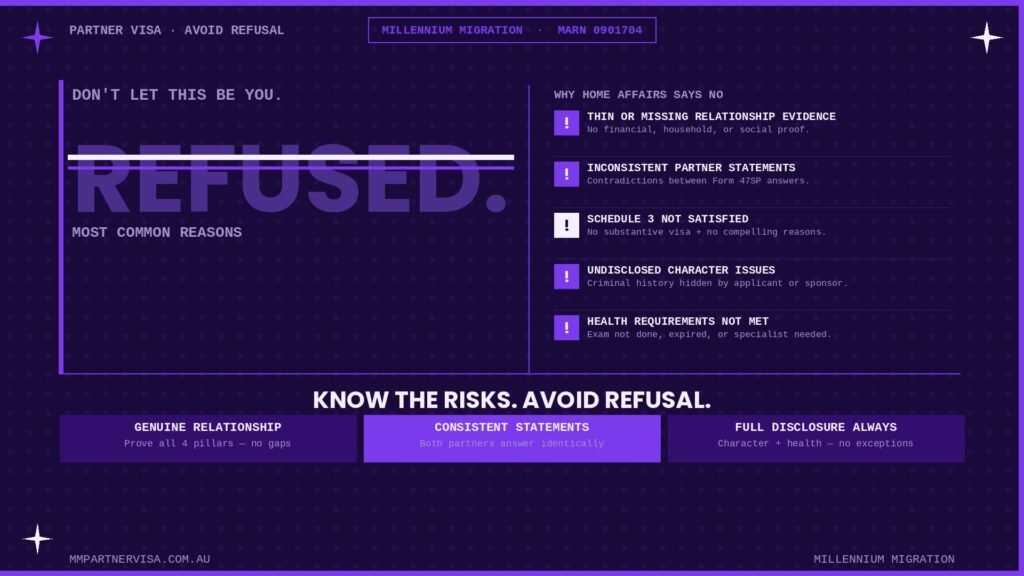
Every year, thousands of Australian partner visa refusal decisions are issued. The good news: most refusals come from preventable mistakes, not impossible cases. So understanding why partner visas fail is the first step to making sure yours doesn’t. Furthermore, working with an experienced team can help you sidestep these common pitfalls completely. Here are the 10 most common reasons in 2026.


Key takeaways
- Most partner visa refusal decisions come from weak evidence, not bad relationships.
- The most dangerous refusal ground is PIC 4020 — false or misleading info — which carries a 3-10 year ban on future visas.
- Schedule 3, the 12-month rule, and sponsor character issues are the most common technical refusal grounds.
- Inconsistencies between applicant and sponsor statements alone can trigger refusal.
- The 2026 integrity push means tighter scrutiny — particularly on social media, financial evidence, and document verification.
- Most refusals are preventable with proper case preparation by Millennium Migration before lodgement.
In this guide
- 1. Weak relationship evidence
- 2. PIC 4020 — false or misleading info
- 3. Inconsistent statements
- 4. Failing the 12-month de facto rule
- 5. Schedule 3 not satisfied or waived
- 6. Sponsor eligibility or character
- 7. Health or character failures
- 8. Missed deadlines for requests
- 9. Bogus or altered documents
- 10. Previous visa refusals not addressed
- What to do if you’ve been refused
- Frequently asked questions
1. Weak relationship evidence
This is the single most common reason for a partner visa refusal. The Department isn’t necessarily saying your relationship isn’t real — it’s saying you haven’t proven it convincingly.
The four pillars problem
The Department assesses relationships across four areas: financial, household, social, and commitment. So if one pillar is thin, the whole application looks weaker. Couples often focus heavily on photos while neglecting joint bank accounts or shared utilities.
Common evidence weaknesses
- Only a few months of joint financial activity (not enough history)
- Photos all from one event or short period (not covering the relationship timeline)
- No mail or bills in both names at the same address
- Weak or generic Form 888 statutory declarations
- No evidence of social recognition as a couple
2. PIC 4020 — false or misleading info
This is the most dangerous refusal ground. Public Interest Criterion 4020 applies when the Department finds you’ve provided false or misleading information — even unintentionally.
Why PIC 4020 is so severe
A PIC 4020 finding doesn’t just refuse your current application. It can trigger a 3 to 10 year ban on any future Australian visa. So this is the worst possible outcome — and it’s often caused by carelessness rather than deliberate fraud.
Common triggers
- Failing to disclose previous visa refusals or cancellations
- Omitting prior marriages or relationships
- Hiding criminal history (including from sponsor)
- Incorrect dates that contradict immigration records
- Bogus or altered supporting documents
- Inconsistent answers across multiple visa applications
2026 verification tools
The Department now uses AI-driven verification to cross-reference employment claims, bank transactions, and social media. So inconsistencies that might have slipped through years ago are now caught quickly.
The honest disclosure principle: Always declare prior visa refusals, marriages, character issues, and any past complications. Failing to disclose is almost always worse than the underlying issue. So if you have anything in your background to disclose, contact Millennium Migration before lodging — Sam will frame it correctly.

3. Inconsistent statements
Both partners write personal statements describing the relationship. If the dates, locations, or key events contradict each other, the Department questions the genuineness of the entire claim.
Common contradictions
- Different dates for when you met, dated, or moved in together
- Conflicting versions of how you were introduced
- Different cities listed for the same period
- Inconsistent timeline of trips, holidays, or major events
- Different reasons given for breakup-reconciliation gaps
How to prevent this
Coordinate the basic timeline before either partner writes their statement. Build a master timeline together. So when each partner writes independently, they’re working from the same agreed framework. This sounds obvious but couples often skip it.
4. Failing the 12-month de facto rule
For unmarried couples, the 12-month de facto rule is a strict time-of-application test. Lodging at month 11 means refusal — even if you’ve been together longer in spirit.
Common errors
- Counting dating time instead of cohabitation
- Lodging one day too early
- Counting long-distance time as de facto
- Including a brief breakup period in the 12 months
How to avoid this refusal
Either wait the full 12 months, or use one of the three exemptions: relationship registration, having a child together, or compelling circumstances. For the deep dive, see our 12-month de facto rule guide.
5. Schedule 3 not satisfied or waived
For onshore applicants who don’t hold a substantive visa, Schedule 3 is the hurdle. Lodging without satisfying it — or without arguing the compelling reasons waiver properly — leads to refusal.
Common Schedule 3 refusal patterns
- Lodging more than 28 days after substantive visa expiry (failing clause 3001)
- Not providing compelling reasons evidence in the submission
- Generic “we want to be together” claims instead of specific hardship arguments
- Failing to address each element of clause 3004’s multi-limb test
Schedule 3 cases are particularly complex. So see our Schedule 3 guide for the full breakdown — and contact Millennium Migration before lodging any Schedule 3 case.
6. Sponsor eligibility or character
A surprising number of refusals come from the sponsor side, not the applicant.
Common sponsor-related refusal grounds
- Sponsor exceeded the 2-sponsorship lifetime limit
- Sponsor still within the 5-year waiting period from a previous partner visa
- Sponsor has registrable offences (particularly with children involved)
- Sponsor failed to disclose criminal history
- Sponsor not actually living in Australia at time of decision
Most of these are avoidable with proper checking before lodgement. For the full guide, see our sponsor eligibility and obligations guide.
7. Health or character failures
Health-related refusals
Conditions that would impose significant healthcare costs (HIV, hepatitis, severe disabilities, organ transplant requirements) can lead to refusal — though partner visas allow health waivers in compelling circumstances.
Character-related refusals
Applicants with serious criminal history may fail Section 501 of the Migration Act. The most problematic:
- Substantial criminal record (12+ months imprisonment)
- Association with criminal organisations
- Past involvement in violent or sexual offences
- Risk of future offending in Australia
So if either applicant or sponsor has a criminal history, get advice from Millennium Migration before lodging. Honest disclosure with proper framing is far better than discovery during processing.
8. Missed deadlines for requests
During processing, the Department may issue a Section 56 request (further information) or a natural justice letter (notice of intended refusal). Missing these deadlines is one of the most preventable causes of refusal.
The deadlines that catch people out
- Section 56 requests: Usually 28 days to respond
- Section 57 natural justice letters: Usually 28 days, sometimes shorter
- Health undertaking deferrals: 6 months
- Sponsor character updates: 14 days from any change
Why deadlines get missed
- Notifications land in ImmiAccount, not email
- Couples don’t check ImmiAccount regularly during the wait
- Email notifications go to spam or old addresses
- Travel or life events disrupt response capacity
So check ImmiAccount weekly during processing — and respond to any Department contact immediately. If you receive a natural justice letter, contact Millennium Migration within 48 hours.
9. Bogus or altered documents

Submitting bogus, altered, or fabricated documents is a serious refusal ground that triggers PIC 4020 automatically — meaning the 3 to 10 year ban applies.
What counts as “bogus”
- Forged signatures on Form 888 declarations
- Photoshopped photos to fake shared trips
- Fake bank statements or employment letters
- Backdated leases or utility bills
- Fraudulent birth certificates or marriage certificates
- Translations that don’t match the originals
2026 detection methods
The Department now uses AI-driven document verification and can cross-reference documents with state and federal databases, ATO records, Medicare claims, and overseas authorities. So fraudulent documents that might have passed years ago are now routinely flagged.
Never submit altered documents. The temptation is real for couples missing one piece of evidence — but the consequences are catastrophic. PIC 4020 affects both partners for years and can prevent future visa grants. If you don’t have a particular document, contact Millennium Migration for guidance on alternatives.
10. Previous visa refusals not addressed
If either partner has had a previous Australian visa refused or cancelled, that history must be addressed openly in the partner visa application. Hiding it triggers PIC 4020.
Common previous refusals affecting partner visas
- Student visa refused on Genuine Temporary Entrant grounds
- Visitor visa refused for suspected immigration intent
- Previous partner visa refused (genuine relationship not established)
- Skilled visa refused on points test or health/character
How to handle previous refusals
- Disclose every previous refusal in your application
- Address the previous refusal reason in your personal statement
- Demonstrate that the current circumstances are different
- Get migration agent help — these cases need careful framing
What to do if you’ve been refused
If you’ve received a refusal decision, time matters. The deadlines for review are short and missing them usually closes off your options.
Immediate steps
- Read the decision record carefully — the case officer’s reasoning is crucial
- Note the appeal deadline — usually 21 days for onshore cases, longer for some offshore
- Contact Millennium Migration immediately — Sam handles ART appeals and Ministerial intervention requests
- Do not lodge a new visa application before getting advice — this can lock in the refusal
Review options
- ART (Administrative Review Tribunal) — formal merits review of the refusal
- Ministerial intervention — last resort for compelling cases
- Federal Court judicial review — for legal errors in the decision
- New application — sometimes the best strategy with proper case preparation
Don’t appeal alone. Refusal review work requires legal precision and strategic framing. The ART success rate for properly prepared partner visa appeals is significantly higher than DIY appeals. Contact Millennium Migration within 48 hours of receiving a refusal.
Frequently asked questions
What’s the most common reason partner visas get refused?
Weak or insufficient evidence of a genuine relationship. The Department isn’t usually saying the relationship isn’t real — they’re saying it hasn’t been proven convincingly across all four pillars (financial, household, social, commitment).
If my partner visa is refused, do I lose my application fee?
Yes. The $9,365 application charge is non-refundable, even if the application is refused. This is why proper case preparation before lodgement matters so much.
Can I appeal a partner visa refusal?
Yes, most partner visa refusals are reviewable by the Administrative Review Tribunal (ART). The deadline is typically 21 days from the decision notification. Missing this deadline usually closes off review options.
What is PIC 4020 and why is it so serious?
PIC 4020 (Public Interest Criterion 4020) applies when false or misleading information is found in your application. A PIC 4020 finding can trigger a 3 to 10 year ban on future Australian visas — meaning the consequences extend far beyond the current refusal.
How common is partner visa refusal?
Refusal rates vary by year and country of origin. Some recent data suggests around 15-25% of partner visa applications get refused — but most refusals come from preventable mistakes. Decision-ready applications prepared by experienced agents have far lower refusal rates.
Can I apply again immediately after a refusal?
Sometimes, yes. However, lodging a new application before appeals are resolved can compound the issues. If PIC 4020 was triggered, you may face a 3-10 year exclusion. Always get advice from Millennium Migration before lodging again.
If we’re truly in love, why would we get refused?
Genuine relationships still get refused when the evidence package doesn’t convince the case officer. The Department assesses what’s in the file — not what’s in your heart. So genuine love + weak documentation = refusal in many cases.
Does failing the medical mean refusal?
Not automatically. Partner visas allow health waivers in compelling circumstances. So even applicants with conditions like HIV or hepatitis may still be granted if the waiver case is strong. Contact Millennium Migration for any health-related concerns.
What does a “natural justice letter” mean?
A natural justice letter (sometimes called a Section 57 letter) means the Department is preparing to refuse your application but giving you a final chance to respond. This is critical — the window to save the application is short. Contact Millennium Migration within 48 hours of receiving one.
Can a migration agent guarantee no refusal?
No registered migration agent can guarantee any visa outcome — and any agent claiming to do so is breaching the OMARA Code of Conduct. However, properly prepared cases with Millennium Migration have significantly lower refusal rates than DIY applications, particularly in complex matters.
Take the free 2-minute quiz to identify potential refusal risks — or download the free Notion checklist to build your evidence properly.
Related reading
About the author
Sam is the founder of Millennium Migration, based in Melbourne. He handles partner visa refusal appeals, PIC 4020 cases, and complex Schedule 3 matters across Australia.
Sources
- Migration Act 1958 (Cth) — Sections 56, 57, 501 (refusal grounds)
- Migration Regulations 1994 (Cth) — Public Interest Criterion 4020
- Department of Home Affairs — Partner visa requirements
- Administrative Review Tribunal — migration review decisions
This article provides general information only and is current as of June 2026. Visa refusal cases are time-critical — verify deadlines and current requirements at immi.homeaffairs.gov.au. For advice on a refusal or refusal risk, take our quiz or contact Sam at Millennium Migration directly.