
In a partner visa application, the focus usually falls on the applicant. However, the Australian partner visa sponsor carries equal weight in the assessment.
The Department of Home Affairs scrutinises sponsors at every stage — and a sponsor problem can sink an otherwise perfect case. Furthermore, navigating these shifting eligibility benchmarks can be complex. Here’s the complete 2026 guide to sponsor eligibility and obligations.


Key takeaways
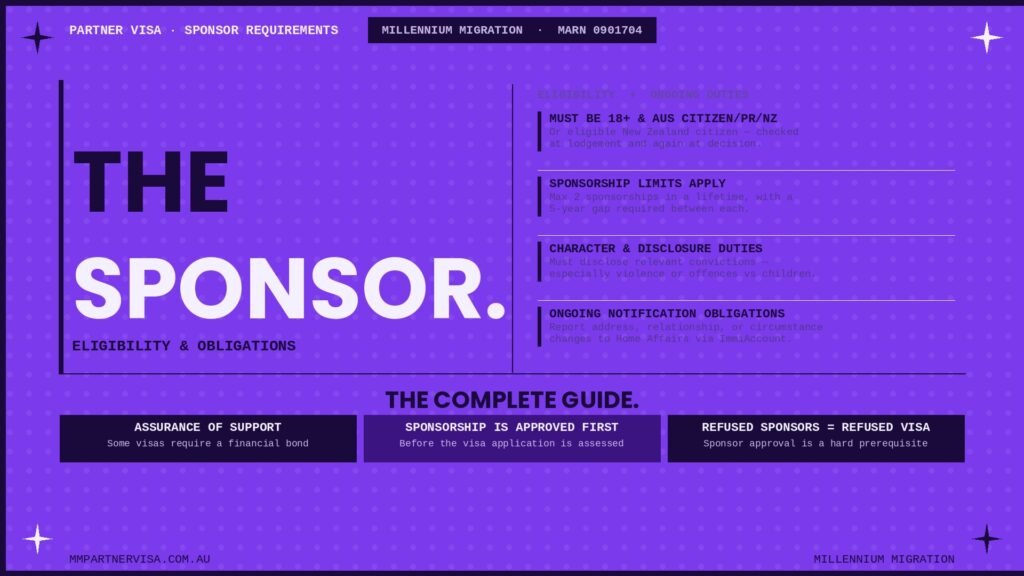
- A partner visa sponsor must be 18+, an Australian citizen, permanent resident, or eligible New Zealand citizen.
- Lifetime limit: Maximum of 2 partner sponsorships, with a strict 5-year waiting period between them. (Waivers apply though).
- Sponsors must pass character checks — including AFP police clearance and overseas police checks for any country lived in for 12+ months since age 16.
- Mandatory disclosure of relevant criminal history is required. Hidden convictions trigger an immediate refusal.
- Sponsors are assessed separately. A sponsor problem can refuse the entire visa — regardless of applicant strength.
In this guide
1. Who Can Be a Partner Visa Sponsor
To be an eligible partner visa sponsor, you must satisfy four core criteria.
Before any relationship evidence is even considered, the sponsor must clear these hurdles:
- Status: Australian citizen, permanent resident, or eligible New Zealand citizen.
- Age: 18 years or older.
- Residency intent: Living in Australia (or genuinely intending to be) when the visa is granted.
- Sponsorship history: Not subject to active sponsorship limits or previous legal penalties.
Eligible New Zealand Citizens:
A “Special Category Visa (SCV) holder” — also called a protected SCV holder or eligible New Zealand citizen — can also sponsor.
This typically applies to NZ citizens living in Australia on a Subclass 444 visa who arrived before specific milestone dates and meet strict reciprocal criteria. Consequently, gaining alignment across the general procedural steps detailed in our comprehensive Australian partner visa framework gives you an extensive overview of cross-border pathways.

2. The 5-Year and 2-Sponsorship Rule
The rule comes from Regulation 2.03A of the Migration Regulations 1994. It states that a de facto partner visa applicant must have been in a de facto relationship with their sponsor for at least 12 months immediately before the application is lodged.
Australian migration law limits how often a person can sponsor a partner. These rules exist to prevent “serial sponsorship” patterns associated with visa fraud.
The 2-Sponsorship Lifetime Limit:
You can sponsor a maximum of two partners in your lifetime for partner visas (this includes a Prospective Marriage Subclass 300 visa).
Therefore, if you’ve already successfully sponsored two partners — even decades apart — you cannot sponsor a third. However, in some circumstances you can sponsor a third person. Strict criteria applies for a waiver scenario.
The 5-Year Waiting Period:
Between sponsorships, you must wait at least 5 years. The clock starts from the date of your previous partner visa lodgement (not the grant date) to the date of the next grant.
For example, if you lodged a partner visa for someone in 2021, you can sponsor a new partner from late 2023 or early 2024. That’s because the time you are waiting for the visa to be processed can count towards the 5 years. Reviewing historical timing parameters via our updated partner visa processing times guide ensures your benchmarks map seamlessly to active case files.
Sponsor as a Former Applicant:
This catches many sponsors off guard. If you came to Australia as a partner visa applicant yourself, you also count toward this rule.
*Note: The Department may also waive the 5-year requirement in extreme, compelling circumstances — such as the death of the previous sponsored partner, or documented family violence.*
*Contact Millennium Migration if you require a sponsorship waiver review.*
3. Character Requirements
The partner visa sponsor must pass character checks.
The Department doesn’t just assess the applicant’s background — it thoroughly scrutinises the sponsor too.
What Sponsors Must Provide:
- Australian Federal Police (AFP) check — National Police Certificate.
- Overseas police certificates — for any country lived in for 12+ months since turning 16.
- Full disclosure of criminal history — even old or minor convictions.
- Family violence orders if relevant (existing or historical).
The Department cross-references sponsor declarations against state and federal databases, so hidden convictions usually surface. Furthermore, preparing your paperwork checklist inside our structural decision-ready guide guarantees your background submissions match rigid internal standards flawlessly.
Consequently, failing to disclose triggers Public Interest Criterion (PIC) 4020 issues, causing a visa refusal based on misleading information.
Minor traffic offences generally don’t prevent sponsorship, but any formal court appearance must be declared openly with the right context.
4. Registrable Offences and Child Safety
A major Department priority focuses on protecting children from harm through the migration system. If children are involved in the application as secondary dependents, sponsor character checks become particularly stringent.
What Is a “Registrable Offence”?
Registrable offences are serious crimes that typically include sexual offences (particularly against children), serious acts of violence, human trafficking, or the production of child abuse material.
A sponsor with a record containing a registrable offence will usually have their sponsorship refused. This refusal cascades, causing the entire partner visa to fail immediately regardless of relationship authenticity. For blended families managing secondary dependent applicants, reviewing our specialized partner visa with children guide outlines custody and sponsor clearance parameters exhaustively.
*Warning: If the sponsor has any conviction history, contact Millennium Migration before lodging. The viability of your strategy depends entirely on the type, severity, and recency of the offence.*
*Sam handles these complex character matters with absolute discretion.*
5. Your Obligations as a Sponsor
Sponsoring a partner isn’t just signing forms. It’s a legal commitment with ongoing obligations.
Core Sponsor Obligations:
- Financial Support: You are legally obligated to provide financial support for your partner during the sponsorship period. This means ensuring they can meet basic living needs like housing, food, and daily care.
- Accommodation: You must ensure adequate accommodation is available for your partner throughout the duration of the obligation period.
- Departmental Cooperation: You must provide updates and respond to Departmental requests during processing. This includes notifying changes in address, employment, or character matters.
- Restricted Welfare Payments: Sponsors generally cannot receive certain restricted social security payments (such as Special Benefit) during the sponsorship period.
In 2026, the Department strictly enforces document verification protocols alongside updated baseline processing fees (e.g., AUD $9,365+ fees), meaning administrative errors carry huge financial risks. For a complete analysis of mandatory document cash flow, checking our hidden costs of a partner visa ledger keeps your baseline budgets secure.

6. Documents the Sponsor Must Provide
- Identity: Current Australian passport, birth certificate, and name change proofs.
- Character: AFP National Police Check, overseas clearances, and disclosure of family violence orders.
- Financial: Most recent ATO Notice of Assessment, last 6 months of payslips, and a current employment letter.
- Sponsorship Forms: Form 40SP (completed and submitted digitally via ImmiAccount) and a detailed personal relationship statement.
7. Reporting Changes During Processing
Sponsorship is a live obligation. You must report modifications to the Department within 14 days via ImmiAccount. Reportable changes include address movements, employment updates, marriages, child births, or a relationship breakdown.
If a relationship breaks down before the temporary visa is granted, the application generally cannot continue. However, if it ends after the temporary 820/309 grant but before permanent residency, the applicant may still progress to permanent residency independently if family violence, shared children, or compelling hardship provisions apply.
8. When Sponsorship Gets Refused
Sponsorship refusals are the unseen failures of the partner visa system. Common grounds for refusal include:
- Exceeding the lifetime sponsorship limit or breaching the 5-year waiting window.
- Having a history of registrable offences or serious recent violent crimes.
- Triggering a PIC 4020 fraud flag by omitting prior criminal records.
- Failing to demonstrate genuine evidence of permanent residency intent in Australia.
If a sponsorship is officially refused, the partner visa application is rejected by default. While these decisions can be appealed to the Administrative Review Tribunal (ART), cases involving serious character issues are incredibly difficult to overturn. For onshore sponsors managing complex threshold status gaps, reviewing our standalone Schedule 3 partner visa guide helps analyze secondary criteria exposures proactively.
Take the free 2-minute quiz to assess your sponsorship eligibility — or download the free Notion checklist to plan your evidence.
Related reading
About the author
Sam is the founder of Millennium Migration, based in Melbourne. He handles complex sponsor character cases, relationship breakdown matters, and family-blended applications across Australia.
Sources
- Migration Regulations 1994 (Cth) — Regulation 1.20J (sponsorship limits) & Regulation 2.03A
- Migration Act 1958 (Cth) — Section 5CB
- Department of Home Affairs — Partner visa sponsorship requirements
This article provides general information only and is current as of June 2026. Sponsor eligibility and statutory obligations are highly complex — always cross-verify operational framework rules directly at immi.homeaffairs.gov.au before lodging. For tailored assistance, contact Sam at Millennium Migration.