
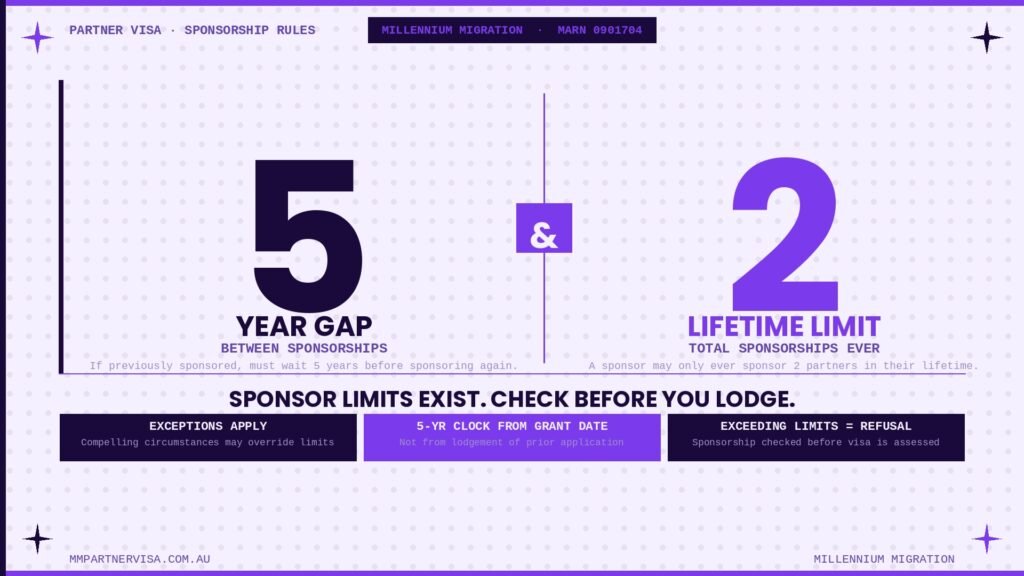
If you’ve sponsored a partner before — or even came to Australia as a partner visa applicant yourself — the partner visa sponsor limit applies to you. So the 5-year waiting period and 2-sponsorship lifetime cap catch many applicants off guard. Furthermore, navigating these rigid structural thresholds can feel incredibly stressful. Here’s exactly how the rules work in June 2026.


Key takeaways
- The partner visa sponsor limit caps lifetime sponsorships at 2 partners, with a 5-year gap measured from previous lodgement to new visa grant.
- This means you can lodge earlier than 5 years if processing time will push the grant past the 5-year mark.
- If you came to Australia as a partner visa applicant yourself, that counts toward your limit.
- The Subclass 300 Prospective Marriage Visa is included in the count.
- Waivers exist for: dependent child of both partners, abandonment by previous spouse, death of previous partner, or evidence of a new long-standing relationship.
- Sponsors with registrable offence limitations have a separate waiver pathway with specific criteria around sentence completion and subsequent charges.
- Breaching the partner visa sponsor limit means automatic refusal — but exceptions can be argued correctly with the right framing.
In this guide
- Why the partner visa sponsor limit exists
- How the partner visa sponsor limit works
- When the 5-year clock starts
- Former applicants also count
- The PMV trap — Subclass 300 counts too
- Exceptions to the partner visa sponsor limit
- How to check your status before lodging
- What happens if you breach the limit
- Frequently asked questions
1. Why the partner visa sponsor limit exists
The partner visa sponsor limit was introduced to prevent serial sponsorship patterns associated with visa fraud. So the rules exist to protect both the integrity of the partner visa program and the people who might otherwise be exploited by repeat sponsors.
The underlying concerns
- Repeat sponsors using the visa system to bring multiple “partners” without genuine commitment
- Patterns of exploitation where vulnerable applicants are abandoned shortly after PR is granted
- The need to ensure each sponsorship represents a genuine, considered family-formation decision
However, these rules also catch genuine couples in unfortunate circumstances — like a sponsor whose previous partner passed away, or someone leaving a family violence situation. So the rules include waivers for exactly these cases.
2. How the partner visa sponsor limit works
The partner visa sponsor limit has two interlocking parts: a lifetime cap and a waiting period. Both must be satisfied — meeting one but failing the other still means you can’t sponsor.
The 2-sponsorship lifetime cap
You can sponsor a maximum of 2 partners in your lifetime. This applies regardless of how long ago the previous sponsorships happened. So even if your first sponsorship was decades ago and the second was 10 years back, you cannot sponsor a third partner without a waiver.
The 5-year waiting period
At least 5 years must pass between your previous partner visa lodgement and the grant of the new application. So the rule isn’t simply “wait 5 years before lodging” — it’s “the new grant must fall on or after the 5-year anniversary of your previous lodgement”. As a result, you can lodge earlier if processing time will push the grant past the 5-year mark.
Both rules must be satisfied. If you’ve already sponsored 2 partners in your lifetime, you cannot sponsor a third even if 20 years have passed (unless a waiver applies). If you’ve sponsored only 1 partner, the 5-year rule still applies and must be calculated correctly. So the partner visa sponsor limit operates as a double safeguard.

3. When the 5-year clock starts (and ends)
This is the single most misunderstood detail about the partner visa sponsor limit — and getting it right can mean lodging years earlier than couples typically assume.
The actual rule: previous lodgement to next grant
The 5-year period runs from the lodgement date of your previous partner visa application to the grant date of your new application. So the requirement isn’t that 5 years must pass before you lodge again — it’s that 5 years must pass before the new visa is granted.
Because partner visa processing typically takes 12–24 months, this means you can lodge well before the 5-year mark, as long as the grant will fall on or after the 5-year anniversary of your previous lodgement.
Strategic example
Worked example: If you lodged your previous partner visa in January 2022 and the current processing time is 18 months, you can lodge your new partner visa as of July 2025 — not January 2027. The new visa will be granted around January 2027, which satisfies the 5-year rule. So waiting until January 2027 to lodge would cost you 18 months of unnecessary delay.
Why this distinction matters
Many couples (and even some agents) assume the 5-year rule means waiting 5 years before lodging the new application. As a result, they delay lodgement unnecessarily — losing months or even years of processing time. The actual rule is more strategic, so understanding it properly can fast-track your timeline. Reviewing historical case gates via our partner visa processing times guide ensures your milestones map perfectly to current agency queues.
How to calculate your earliest lodgement date
- Find the lodgement date of your previous partner visa application
- Add 5 years — this is the earliest possible grant date for your new application
- Subtract the current published partner visa processing time
- The result is your earliest realistic lodgement date
However, this requires precise timing. Lodging too early — even by a single month — can trigger refusal if processing happens to be faster than expected. So contact Millennium Migration to verify your exact timeline before lodging.
4. Former applicants also count
Here’s the trap that catches the most people. If you came to Australia as a partner visa applicant yourself, that counts toward your partner visa sponsor limit. So you can’t escape the rules by saying “I’ve never sponsored before”.
How this works in practice
If you arrived in Australia as the applicant on someone else’s partner visa application, and now you want to sponsor a new partner:
- The 5-year clock runs from the date your original partner visa was lodged
- That previous application counts toward your 2-sponsorship lifetime cap
- You can lodge a new sponsorship earlier than 5 years if processing time will push the grant past the 5-year mark
- So if you arrived in Australia on a partner visa lodged in 2020, and processing time is 18 months, you can lodge a new sponsorship from around mid-2023
Why this rule exists
The Department designed this to prevent a specific pattern: someone migrates as a partner visa applicant, divorces shortly after PR, then immediately sponsors a new partner from their home country. So treating both cases symmetrically closes that loophole.
5. The PMV trap — Subclass 300 counts too
Many people assume only granted partner visas trigger the partner visa sponsor limit. So they’re surprised to learn the Prospective Marriage Visa (Subclass 300) also counts.
What this means in practice
- If you sponsored a PMV that was granted (whether the marriage happened or not), it counts
- If you sponsored a PMV that was lodged but later withdrawn, it may still count toward the 5-year wait
- The PMV → 820 transition counts as one sponsorship, not two
The combined sponsorship sequence
If you sponsored a PMV and the relationship led to a Subclass 820 application, this is treated as one continuous sponsorship — not two separate sponsorships. So you’ve only used one of your two lifetime allowances.
6. Exceptions to the partner visa sponsor limit
Migration law allows for a waiver of the partner visa sponsor limit in specific circumstances. So if you’re within the restriction period but have genuine reasons, you may still be able to sponsor.
General sponsorship limit waivers
Available waiver grounds include:
- Dependent child of both partners — where you and your new partner have a child who is dependent on each of you
- Abandonment by previous spouse — where the previous spouse abandoned the sponsor, and there are children dependent on the sponsor requiring care and support
- Death of previous partner — where your previously sponsored partner has passed away
- Evidence of a new long-standing relationship — demonstrating that the current relationship is genuine, ongoing, and has matured over a significant period
Registrable offence waivers
If your sponsorship limitation is based on being convicted of a registrable offence, separate waiver criteria apply. The Department may grant a waiver if:
- You have completed the sentence imposed for the registrable offence (including any period of release under recognisance, parole or licence), and more than 5 years have passed since sentence completion before the sponsorship application was lodged; and
- You have not been charged with a registrable offence since completing that sentence, or any subsequent charge has been withdrawn, dismissed, or otherwise disposed of without the recording of a conviction; or
- There are compelling circumstances affecting the sponsor and the visa applicant that should be taken into consideration.
What makes a waiver case strong
- Documentary evidence of the compelling circumstances (court orders, death certificates, police records, child birth certificates)
- Evidence that the new relationship is genuinely separate from the previous one
- Demonstrated time gap and life changes between the relationships
- Strong evidence of the genuineness of the current relationship — well beyond minimum requirements
- For registrable offence waivers: complete sentence documentation, certified court records, evidence of rehabilitation
Therefore, running a comprehensive health screening in parallel protects your household stream from separate processing failures. Confirming medical exam frameworks within our partner visa health requirements guide ensures you map related milestones cleanly.
Waiver submissions need careful framing. The Department has discretion — but they exercise it only when the case is presented properly. So Millennium Migration handles these submissions regularly. Sam frames the compelling circumstances clearly and provides the documentary backing the Department needs.
7. How to check your status before lodging
Before lodging any partner visa application, the sponsor should verify their position against the partner visa sponsor limit. So this is one of the first checks Millennium Migration runs in case assessment.
Self-assessment questions
Ask yourself:
- Have you ever sponsored a partner visa application? Include PMVs, 820/801, 309/100.
- Did you arrive in Australia as a partner visa applicant? If yes, when was that application lodged?
- If yes to either: What was the lodgement date of the most recent application?
- Adding 5 years to that lodgement date — and subtracting the current partner visa processing time — when can you lodge?
- Including this application, will you have sponsored 2 or fewer partners in total?
- If a waiver might apply, what’s the basis? (dependent child, abandonment, death of previous partner, new long-standing relationship, registrable offence criteria)
Records you should locate
- Your own previous partner visa grant letter (if applicable)
- Any previous partner visa sponsorship correspondence
- ImmiAccount records showing application history
- Old emails confirming previous lodgement dates
Furthermore, checking alternative streams via our strategic partner visa sponsor requirements guide details how background clearances bound these sponsor rules securely.

8. What happens if you breach the partner visa sponsor limit
If you lodge a partner visa where the sponsor breaches the partner visa sponsor limit and no waiver applies, the consequences are significant.
Immediate consequences
- The sponsorship will be refused
- The partner visa application will also be refused (since both are assessed together)
- In 2026, the Department strictly enforces document benchmarks alongside updated baseline processing fees (e.g., AUD $9,365+ fees), meaning a refusal carries massive financial losses.
- The applicant cannot progress to PR through this application
Reviewing your document package through our comprehensive decision-ready guide guarantees you cross-verify every hidden threshold restriction early to avoid automatic refusal. If a refusal notice has already been issued, checking our breakdown on partner visa refusal triggers helps map your ART tribunal path cleanly.
Strategic options if you breach the limit
- Wait it out — if you’re within months of the 5-year mark, waiting is often the simplest option
- Argue a waiver — if compelling circumstances exist, prepare a properly framed waiver submission
- Explore alternative pathways — depending on circumstances, other visa categories may apply
- Marriage timing — for some couples, marriage and BDM registration can affect strategy
So contact Millennium Migration before lodging if there’s any uncertainty about the partner visa sponsor limit. The case strategy depends entirely on your specific timeline and circumstances. For couples reviewing baseline options from the beginning, reading our foundational Australian partner visa framework provides an exhaustive overview of the entire stream landscape.
9. Frequently asked questions
Does the partner visa sponsor limit apply if my previous partner died?
Technically yes, but death of the previous sponsored partner is one of the strongest grounds for waiver. Provide the death certificate and evidence of the genuine new relationship. Contact Millennium Migration to frame the waiver submission properly.
If my first sponsored partner withdrew their application, does it count?
A withdrawn application that was lodged still triggers the 5-year clock from the lodgement date (calculated to the new visa grant date). However, it generally doesn’t count toward the 2-sponsorship lifetime cap. So you’d need to factor in the 5-year timing but wouldn’t lose a “sponsorship slot”.
Does sponsoring a parent or other family member count toward the partner visa sponsor limit?
No. The partner visa sponsor limit applies only to partner visa sponsorships (820/801, 309/100, and 300 PMV). Sponsoring parents, children, or other family members under different visa categories does not affect this count.
If I withdraw my current partner visa application, will it count toward my limit?
A withdrawn application that was validly lodged still starts the 5-year clock (measured to the next grant date). So withdrawing isn’t a clean escape from the partner visa sponsor limit. Get advice from Millennium Migration before withdrawing any application.
Can I lodge before 5 years have fully passed since my previous application?
Yes — this is one of the most important strategic insights. The 5-year rule measures from previous lodgement to next visa grant, not next lodgement. So if processing time is 18 months and your previous visa was lodged January 2022, you can lodge a new application from around July 2025 (because the new grant will fall around January 2027 = exactly 5 years after the previous lodgement). Get the timing exactly right with Millennium Migration to avoid lodging too early.
What are the specific waiver grounds available?
For the general sponsorship limit, waivers can be granted where there’s a dependent child of both partners, abandonment by a previous spouse with dependent children, death of the previous partner, or evidence of a new long-standing relationship. For registrable offence limitations, separate waiver criteria apply involving sentence completion, no subsequent charges, or compelling circumstances. Each ground requires specific documentary evidence.
My previous partner visa was refused. Does it still count?
A refused application typically starts the 5-year clock from the original lodgement date but generally doesn’t count toward the 2-sponsorship lifetime cap. The exact treatment depends on the refusal reason — contact Millennium Migration for case-specific advice.
Can I sponsor my new partner if we have an Australian citizen child together?
Having an Australian citizen child together strengthens a waiver case significantly. So you may still be able to sponsor within the 5-year period if the case is framed properly. The “child of the relationship” ground is particularly compelling.
If I’m in a same-sex relationship, do the same sponsor limits apply?
Yes. The partner visa sponsor limit applies equally to all relationship types — same-sex, opposite-sex, married, or de facto. There’s no distinction in how the 5-year rule or 2-sponsorship cap operates.
Does the partner visa sponsor limit apply if my previous sponsorship was 30 years ago?
Yes for the 2-sponsorship cap. The lifetime limit has no expiration — sponsorships from decades ago still count. However, the 5-year wait would obviously have passed, so only the lifetime cap concern remains. If you’ve already used both lifetime slots, you’d need a waiver to sponsor again.
Can I apply for a waiver before lodging the partner visa application?
The waiver isn’t applied for separately. Instead, the compelling circumstances submission is included with the partner visa application itself. So the waiver argument is part of your lodgement bundle — which makes professional preparation critical.
How successful are waiver applications?
Success depends entirely on the underlying circumstances and how the case is framed. Cases involving death, family violence, or compelling family circumstances with strong documentation have much higher success rates than generic “we want to be together” claims. Millennium Migration handles these submissions with the framing they require.
Take the free 2-minute quiz to assess your situation — or download the free Notion checklist for sponsorship strategy planning.
Related reading
About the author
Sam is the founder of Millennium Migration, based in Melbourne. He handles complex sponsorship limit waiver cases, particularly those involving death of previous sponsor, family violence, and compelling circumstances.
Sources
- Migration Regulations 1994 (Cth) — Regulation 1.20J (limitation on approval as sponsor)
- Department of Home Affairs — Partner visa sponsorship limitations
- Department of Home Affairs Procedural Instructions — Sponsorship limit waivers
- Administrative Review Tribunal — sponsorship waiver decisions
This article provides general information only and is current as of June 2026. Sponsorship limit waiver cases are highly case-specific — verify your situation with a registered migration agent. For advice on your specific case, take our quiz or contact Sam at Millennium Migration directly.