
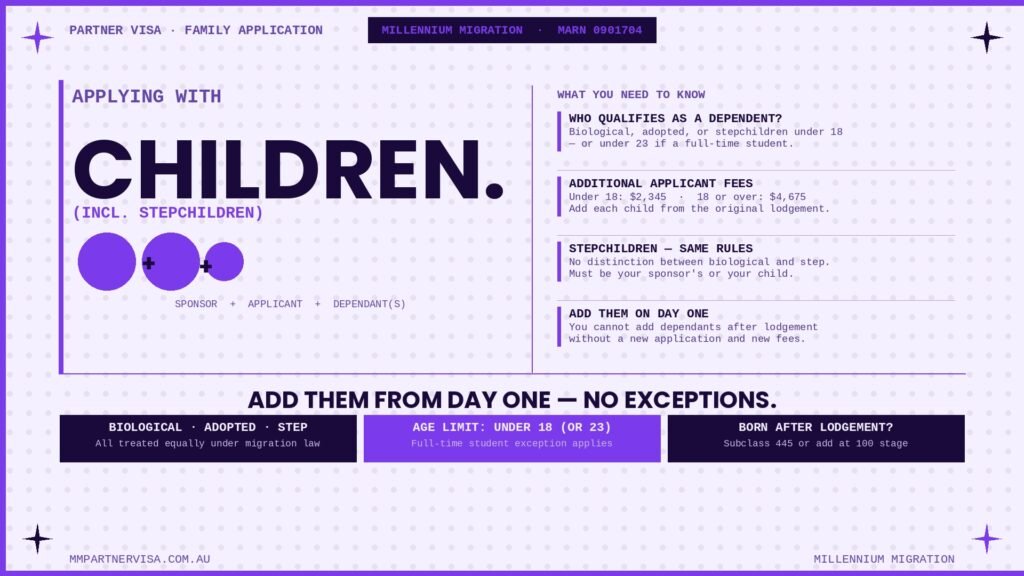
Including children in your partner visa with children application changes the rules — the cost, the evidence, the timing, and even the character checks. Furthermore, navigating these family criteria can feel incredibly complex. So whether the children are biological, adopted, or stepchildren, here’s exactly what to know in June 2026.


Key takeaways
- A partner visa with children includes dependent children as “secondary applicants” — biological, adopted, or stepchildren.
- Additional applicant charges: $2,345 per child under 18, $1,170 per dependent 18+.
- Children 18–23 can be included only if they’re financially dependent, not married/de facto, and (usually) full-time students.
- If the other biological parent isn’t migrating, you’ll need their written consent or evidence of sole custody.
- Mandatory sponsor character checks apply where children are involved — to protect them from harm.
- Newborns after lodgement can be added without an additional fee. So timing matters.
In this guide
- Who counts as a dependent child
- Biological, adopted, and stepchildren
- Costs per additional applicant
- The other parent’s consent
- Sponsor character checks
- Health and character for children
- Non-migrating children — still declared
- Newborns after lodgement
- Evidence to provide for children
- How children strengthen your case
- Frequently asked questions
1. Who counts as a dependent child
Australian migration law defines “member of the family unit” in Regulation 1.12. So who qualifies as a dependent child for a partner visa with children isn’t optional — the rules are precise.
A child can be included if they are:
- Under 18 — automatically eligible as a dependent
- Aged 18 to 23 — only if financially dependent on the applicant, not married or in a de facto relationship, and usually a full-time student
- Over 23 with a disability that prevents independent living — must demonstrate the dependency
Who doesn’t qualify
- Adult children who are financially independent
- Children who are themselves married or in de facto relationships
- Adult children not engaged in full-time study (unless disability applies)
- Children of a previous relationship not legally yours
2. Biological, adopted, and stepchildren
The Department recognises three categories of children for partner visa purposes. Each has slightly different evidence requirements.
Biological children
The simplest category. Provide the child’s birth certificate showing both biological parents. So if you’re the named parent, you can include the child.
Adopted children
Children formally adopted under recognised legal processes can be included. You’ll need:
- Official adoption certificate or court order
- Original birth certificate (showing biological parents)
- Evidence the adoption is recognised under Australian law
Consequently, hague convention adoptions and intercountry adoptions have specific requirements. So contact Millennium Migration if your adoption was done overseas.
Stepchildren
Stepchildren are children of your current partner from a previous relationship. They can be included if:
- You’re in a genuine ongoing relationship with the biological parent
- Your partner has legal custody or guardianship
- The other biological parent provides consent (or is deceased, untraceable, or has lost custody)
Important: Stepchildren cases often involve consent issues with the absent biological parent. So get advice early. Millennium Migration handles stepchild custody complications regularly.
3. Costs per additional applicant
Each child or dependent added to the application incurs an additional government fee. Here’s the June 2026 breakdown:
| Additional applicant | Government fee |
|---|---|
| Child under 18 | $2,345 |
| Dependent aged 18+ | $1,170 |
| Newborn after lodgement | $0 (no additional fee) |
Plus health and police costs
Each child also needs their own:
- Medical examination — $200–$400 per child (less than adults, since fewer tests for under-15s)
- Police clearances — for any country they’ve lived 12+ months (usually only required for older children)
- NAATI translations of birth certificates and supporting documents
Total extra cost example
A family with 2 children under 18: $4,690 in government fees + $500–$800 in medicals + $100–$300 in translations. So budget around $5,500 extra on top of the $9,365 base fee.
4. The other parent’s consent
If a child is migrating with you but the other biological parent isn’t, you need either consent or evidence that consent isn’t required. Therefore, this represents a major structural issue in blended-family applications.
When consent is required
The other biological parent must consent in writing if:
- They share custody or have any legal rights regarding the child
- They’re listed on the birth certificate
- They’re known and contactable
Acceptable evidence of consent
- Written and signed consent letter from the other parent
- Form 1229 (Consent form to grant an Australian visa to a child under the age of 18 years)
- Australian court order granting you sole custody or relocation rights
When consent is NOT required
- The other parent is deceased (provide death certificate)
- You have sole legal custody (provide court order)
- The other parent is genuinely untraceable (provide evidence of search efforts)
- The other parent’s rights have been legally terminated
Don’t try to skip this step. If the other parent objects after the visa is granted, it can lead to international parental abduction claims under the Hague Convention. So always handle consent legally — contact Millennium Migration before lodging if the other parent’s whereabouts or attitude is uncertain. For onshore matters experiencing legal status gaps, checking our dedicated Schedule 3 partner visa guide ensures threshold limitations are managed correctly.
5. Sponsor character checks
The Department now performs mandatory character checks on the Australian sponsor in any partner visa with children case. This is a 2026 priority focused on child safety.
What’s checked
- Australian Federal Police (AFP) check on the sponsor
- State and territory police records
- Working with Children clearances (in some cases)
- Family violence orders or restraining orders
What’s a “registrable offence”
If the sponsor has a registrable offence (typically sexual offences against children, severe violence, or trafficking), the sponsorship can be refused. As a result, the entire visa application fails — regardless of how genuine the relationship is.
Less serious sponsor convictions
Lesser convictions don’t automatically prevent sponsorship. However, the sponsor must disclose them honestly. Failure to disclose can trigger PIC 4020 issues, leading to refusal across the board. If you need to map out your general progression milestones clearly before booking clearances, checking our historical partner visa processing times guide helps you budget your time constraints accurately.
If the sponsor has any criminal history: contact Millennium Migration before lodging. The strategy depends entirely on the type and recency of conviction. Honest, complete disclosure with the right framing usually keeps applications alive.
6. Health and character for children
Children included as secondary applicants must meet the same health and character standards as adults.
Health requirements for children
- Under 11: Medical examination only — no chest X-ray, no blood tests
- Age 11–14: Medical examination plus chest X-ray
- Age 15+: Full adult standard — medical, X-ray, HIV, serum creatinine
So young children typically only need a basic medical exam — much cheaper than adult exams. To prepare for these distinct clinical checks, tracking the procedural steps inside our updated partner visa health requirements guide ensures your appointments map cleanly to target timelines.
Character checks for children
Children under 16 generally don’t need police checks. So character clearance applies only to:
- Children aged 16 and over who’ve lived 12+ months in any country
- Cases where the Department flags a specific concern
7. Non-migrating children — still declared

You must declare all your children on your partner visa application — even those who aren’t migrating with you. Consequently, this represents a common compliance trap.
Why this matters
Failing to declare children — even adult ones living elsewhere — is grounds for PIC 4020 refusal. The Department uses this as a screening tool: hidden family members suggest broader misrepresentation.
Non-migrating children still need health checks
Here’s the surprise: even non-migrating dependent children may need health checks. This is called the “one fails, all fail” rule. If a non-migrating child has a serious health condition, the Department may still refuse your application on health grounds. Furthermore, evaluating your document package through our comprehensive decision-ready guide guarantees you cover every unexpected declaration line cleanly.
8. Newborns after lodgement
If a child is born to you and your sponsor after you lodge the partner visa application but before a decision is made, you can add them to the application — at no additional fee.
How to add a newborn
- Notify the Department through ImmiAccount within 14 days of the birth
- Upload the birth certificate showing both parents
- Upload the child’s passport (apply for one if needed)
- Complete the additional applicant form
Why this strengthens your case
A child born during processing isn’t just an additional applicant — it’s strong relationship evidence. So newborns often unlock the “combined grant” pathway, where both temporary and permanent visas are granted together. As a result, you potentially skip the 2-year wait between stages. Understanding the structural progression from a subclass 820 vs 801 pathway sequence illustrates how these combined grants bypass traditional holding gates entirely.
9. Evidence to provide for children
For every child included in your application, you’ll need:
Identity documents
- Birth certificate (NAATI-translated if not in English)
- Current passport
- Recent passport-style photos
- Adoption certificate (if applicable)
Relationship and custody documents
- Written consent from the other parent (Form 1229)
- Court orders relating to custody, residence, or relocation
- Death certificate of other parent (if deceased)
- Evidence of sole custody arrangements
For dependent children aged 18+
- Evidence of financial dependency (bank statements showing parental support)
- Enrolment in full-time study
- Statutory declaration confirming they aren’t married or in a de facto relationship
- Medical evidence if dependency is due to disability
10. How children strengthen your case
Including children in a partner visa with children application doesn’t just add cost — it adds significant evidence weight.
A child of the relationship waives the 12-month de facto rule
If you have a biological or adopted child together, the 12-month de facto requirement is waived. So you can lodge immediately regardless of how long you’ve been together. Reviewing the historical exceptions listed inside our foundational Australian partner visa framework gives you an exhaustive roadmap of these structural exemptions.
Combined grant pathway
Couples with a child of the relationship who’ve been together 2+ years qualify for combined grant assessment. So both temporary and permanent visas can be granted together — saving 2+ years of processing.
Strongest commitment evidence
The Department considers shared children some of the strongest possible evidence of a genuine, continuing relationship. Therefore, it shifts focus away from things like joint bank accounts and toward the irrefutable evidence of family life. Managing this documentation process alongside translation outlays requires a transparent look at your total cash flow plan, which you can map out via our hidden costs of a partner visa ledger breakdown.
11. Frequently asked questions
Can I include my partner’s children from a previous relationship?
Yes, as stepchildren. Your partner must have legal custody or guardianship, and the other biological parent must consent (or be deceased, untraceable, or have lost custody rights). Contact Millennium Migration if the custody situation is complex.
What if my child’s other parent refuses consent?
Without consent, you typically can’t include the child as a migrating applicant. Options include applying to an Australian court for relocation orders, or proceeding with the partner visa for yourself only and addressing the child’s situation separately. Get advice from Millennium Migration — these cases are sensitive and time-critical.
Can I add a child after my partner visa is granted?
Once your partner visa is granted, you can’t add children to it directly. Instead, your child would need to apply through the “subsequent entrant” stream — typically a separate Child visa (subclass 101 or 802) with its own fee and processing time.
Do my non-migrating children still need to be on the application?
Yes — you must declare all your children, even those not migrating. Failure to declare can trigger PIC 4020 refusal. Non-migrating children may also need health checks under the “one fails, all fail” rule.
My child is 20 and at university — can I include them?
Yes, if they meet the dependent child criteria: aged 18–23, financially dependent on you, not married or in a de facto relationship, and in full-time study. You’ll need to provide evidence of all four factors. The additional applicant fee is $1,170.
Does my newborn need health checks?
Newborns typically don’t need separate health checks beyond standard infant health reports if added during processing. However, this depends on the case. Children added after a few months of age usually need at least a basic medical examination through Bupa or a panel physician.
How long does adding children to the application take?
If children are included at lodgement, they’re assessed together with the primary applicant. So no separate processing time. If added after lodgement (using Form 1436), expect the addition to be processed within a few weeks — but the underlying case may not be delayed.
Can my partner’s adult children be included?
Stepchildren over 18 are very difficult to include. They’d need to be financially dependent on your partner, not married, in full-time study, and have appropriate evidence of dependency. So in practice, most adult stepchildren apply through a separate visa pathway.
What if a child has a disability?
Children with disabilities can still be included as dependents — including adult children whose disability prevents independent living. However, additional health assessments may apply, and significant healthcare cost projections could trigger health requirement issues. Contact Millennium Migration before lodging for any disability-related case.
Can the sponsor’s other children from a previous relationship be on the visa?
No. The sponsor is the Australian citizen or permanent resident — their existing children don’t need a visa. Only the applicant’s children (biological, adopted, or stepchildren from the partner’s previous relationship) are added as secondary applicants.
Take the free 2-minute quiz — or download the free Notion checklist to plan your evidence and lodgement timing.
Related reading
About the author
Sam is the founder of Millennium Migration, based in Melbourne. He handles partner visa cases involving family migration, custody issues, stepchildren, and complex character matters across Australia.
Sources
- Migration Regulations 1994 (Cth) — Regulation 1.12 (definition of “member of the family unit”)
- Department of Home Affairs — Partner visa fees and additional applicant charges
- Department of Home Affairs — Form 1229 (Consent form to grant an Australian visa to a child under the age of 18 years)
- Department of Home Affairs — Form 1436 (Adding an additional applicant after lodgement)
- Hague Convention on the Civil Aspects of International Child Abduction
This article provides general information only and is current as of June 2026. Family migration matters involving children are sensitive and time-critical — verify current requirements at immi.homeaffairs.gov.au. For advice on a partner visa with children, take our quiz or contact Sam at Millennium Migration directly.