
Partner visa interview questions are one of the least understood parts of the process, and the anxiety they create is usually out of proportion to what they actually mean. Here’s what officers really ask, why they push back on your answers, and what a Section 56 request arriving an hour later does and doesn’t signal.


Key takeaways
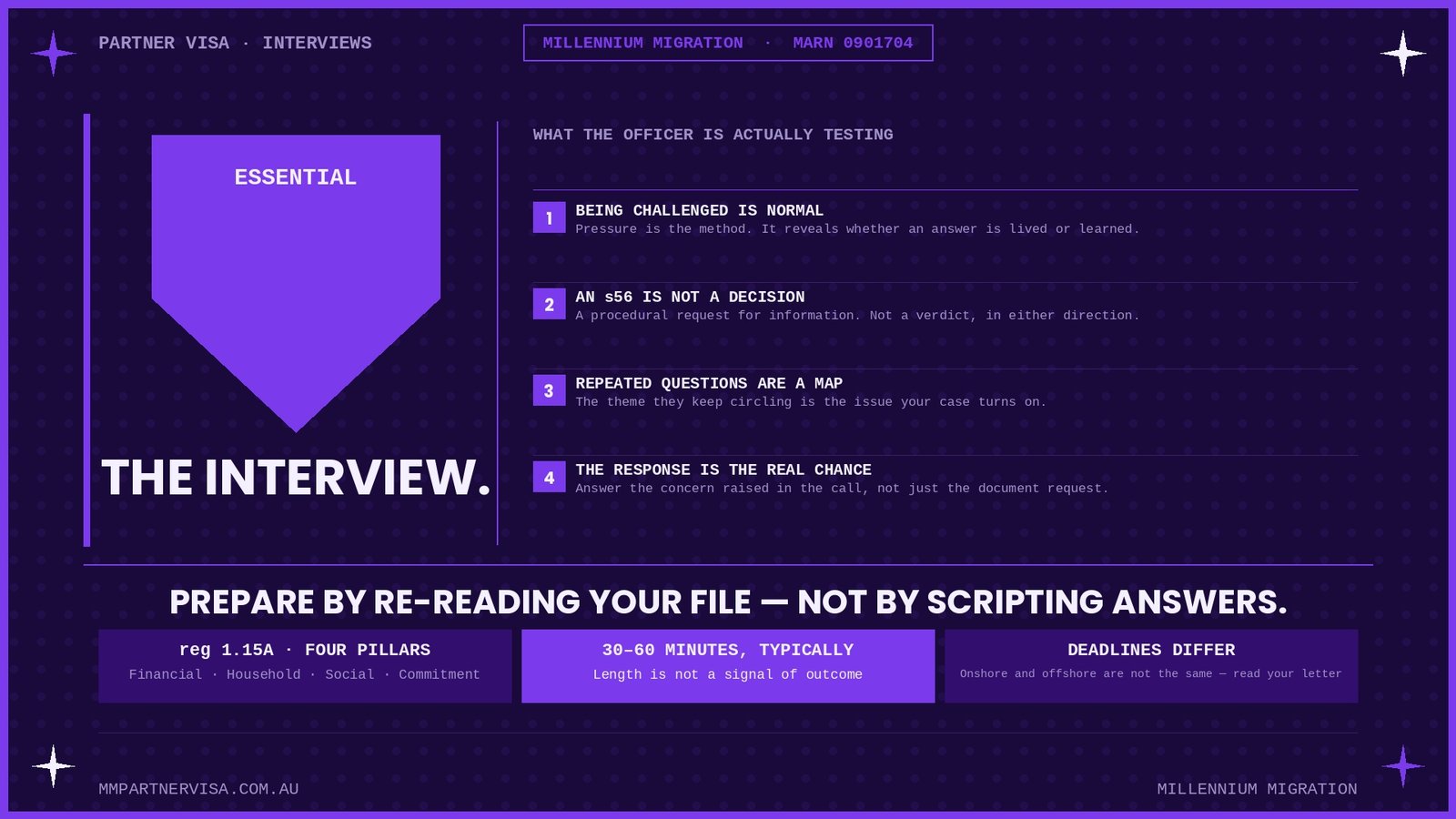
- Partner visa interview questions test genuineness under pressure. Being challenged is normal, and it is not a signal of imminent refusal.
- A Section 56 request is a procedural step, not a decision and not a prediction of one. What matters is how you answer it.
- Officers repeat questions across the interview and the s56 to test consistency between your spoken and written accounts.
- Every question maps to a legal test — regulation 1.15A for partner visas, or the intention-to-marry criteria for Subclass 300.
- Preparation means re-reading your file, not scripting answers. Rehearsed answers damage credibility more than honest hesitation does.
- Your s56 response after an interview is usually the last real chance to address the officer’s concerns before a decision.
- Millennium Migration reviews cases for applicants who have just come off a difficult interview.
In this guide
- Why partner visa interview questions feel like an interrogation
- Is an s56 request after the interview a good sign?
- The partner visa interview questions that caught this applicant off guard
- Why officers repeat questions you already answered
- The legal test behind partner visa interview questions
- Common partner visa interview questions
- How to prepare for partner visa interview questions
- What to do when an s56 request arrives
- Partner visa interview questions: FAQ
Recently a Millennium Migration client had an interview that shook her badly enough that she messaged us the same afternoon, still rattled.
She had waited more than a year on an offshore Prospective Marriage visa (subclass 300) application.
The interview finally came. Instead of the gentle confirmation call she expected, she got an officer who pushed back on almost everything she said.
Here is how she described it:
“The officer kept challenging me. Why hadn’t we booked a wedding venue? Why hadn’t we prepared anything for the wedding? Why hadn’t we had a traditional engagement ceremony? Why did our relationship seem so unusual? They made comments suggesting our relationship might not seem genuine enough. They didn’t really ask me about anything else — just the wedding. And I had already explained all of this in writing, months ago, in response to their first request for information.”
About an hour after the call ended, a second s56 request arrived.
It asked for an updated police clearance from her home country, and another health examination.
Her question was the one almost everybody asks in that moment: is this a good sign or a bad sign?
That question is the reason for this article.
Why partner visa interview questions feel like an interrogation
A case officer conducting an interview is not making conversation. They are testing a legal proposition.
For a partner or prospective marriage application, the officer must be satisfied of something no document proves on its own.
That two people genuinely intend a shared life together.
Documents can be manufactured. Photos can be staged. Statutory declarations can be written by someone else.
However, a live unscripted conversation is the one piece of evidence an applicant cannot prepare their way out of.
The technique is therefore deliberate. Officers press. They repeat. They express doubt out loud to see how you respond.
Partner visa interview questions are built to create pressure, because pressure reveals whether an answer is lived or learned.
This is why so many applicants come off an interview convinced they have been refused. Being challenged feels like being disbelieved.
Usually it just means the officer was doing the job properly.
Is an s56 request after the interview a good sign?
Section 56 of the Migration Act 1958 lets a decision-maker request further information before deciding an application.
It is a procedural power, nothing more. An s56 request is not a decision, not an indication of one, and not a promise of one.
There is useful context in what was requested in this case, though.
Police certificates and immigration health examinations both have limited shelf lives, generally around twelve months.
An officer asks for a fresh police clearance and a repeat medical on a file that has sat for over a year.
The practical reading is that the earlier documents have expired, or are about to.
Character and health checks are grant-stage requirements. Requesting current ones is consistent with a file being worked through.
Practitioner note from Sam: that context is not a prediction, and I want to be careful here. The relationship criteria still have to be met. An officer can be working through the administrative steps while remaining genuinely unsure about genuineness — both things can be true at once. Anyone who tells you an s56 request guarantees an outcome, in either direction, is guessing. What matters far more is how you answer it, which is where Millennium Migration focuses when clients come to us mid-process.
The partner visa interview questions that caught this applicant off guard
Look again at what she was actually asked. Every question circled a single theme.
“Why haven’t you booked a wedding venue?”
For a prospective marriage application, the officer must be satisfied there is a genuine intention to marry.
A venue booking. A deposit receipt. A celebrant’s confirmation. A Notice of Intended Marriage.
These are the tangible artefacts of a real wedding plan.
The honest answer for most couples is that they will not put thousands of dollars on a venue without knowing whether or when the visa will be granted.
That is a completely reasonable answer. However, it is also an answer the officer will not supply for you.
You have to say it clearly, and ideally back it up — a venue quote, an email exchange with a celebrant, a message thread with family about dates.
“Why haven’t you had a traditional engagement ceremony?”
This one carries a cultural assumption, and it is worth naming that directly.
In many communities a formal engagement ceremony is the moment a relationship becomes real to both families.
Its absence can read as a red flag to an officer familiar with that culture.
However, there are countless ordinary explanations.
Distance, cost, family illness, a family split across two countries, or simply a couple who did not want one.
Again — the officer will not assume the innocent explanation. Say it.
“Why does your relationship seem so unusual?”
This is not a question. It is an invitation to respond to a concern the officer already holds.
Something in the file does not fit the pattern they expect.
A large age gap. A short courtship. Limited time together in person. A marriage plan with no visible preparation.
When you hear a comment like this, treat it as the most important thing said in the whole call.
The officer has just told you exactly what their doubt is. Answer that.

Why officers repeat partner visa interview questions you already answered
Her frustration was understandable. All of this had been covered in the first s56 response, in writing, months earlier.
There are three reasons this happens, and none of them mean your written response was ignored.
Consistency testing. A written response is prepared, considered, sometimes agent-assisted. A spoken answer is not.
Asking the same thing again in a different setting is the simplest way to check the two versions match.
The written answer did not fully land. If an explanation was general where it needed to be specific, the officer may still be unsatisfied.
Repeating the question gives you a second chance to fill the gap.
Natural justice. Where an officer is minded to refuse on a particular basis, they are generally required to put that concern to the applicant first.
Section 57 of the Migration Act 1958 deals with this directly for certain adverse information.
Repeated questions on one theme can be the officer discharging that obligation.
That third reason is why a narrow, repetitive interview is not the disaster it feels like.
Being asked about your wedding plans four different ways means the wedding plans are the issue. You now know what the case turns on.
Most applicants never get that clarity.
The legal test behind partner visa interview questions
It helps to know what the officer is assessing, because partner visa interview questions are never random.
For a Prospective Marriage visa (subclass 300), the criteria in Schedule 2 of the Migration Regulations 1994 require, in substance:
- both parties are at least 18
- they have met in person and are personally known to each other
- they genuinely intend to marry within the visa’s validity period
- they genuinely intend to live together as spouses
- there is no legal impediment to the marriage
For Partner visas (subclass 820/801 and 309/100), the test is different.
It is the definition of spouse or de facto partner in the Migration Act 1958 and regulation 1.15A.
That regulation directs the decision-maker to consider four categories.
Financial aspects, the nature of the household, social aspects, and the nature of the commitment.
Every interview question maps onto one of those elements.
Wedding venue and engagement ceremony questions go to intention to marry. Questions about who pays the bills go to financial aspects.
Questions about whether his mother knows your birthday go to social aspects and commitment.
Once you can hear which element a question aims at, you stop giving thin answers to important questions.
Common partner visa interview questions
The exact list varies by post, officer and case.
However, across Millennium Migration’s files, partner visa interview questions cluster into recognisable groups.
How the relationship began
- How and when did you first meet?
- Who made contact first, and how?
- When did the relationship become serious?
- When and how did the proposal happen? Who was present?
Daily life and knowledge of each other
- What does your partner do for work? What are their hours?
- Who are their immediate family members?
- What did you talk about the last time you spoke?
- What does your partner do on a typical weekend?
- Do they have any health conditions or allergies?
Financial arrangements
- Do you have any joint accounts or shared expenses?
- Has either of you sent money to the other? How often?
- Who will support you when you arrive in Australia?
- Do you know what your partner earns?
Social and family recognition
- Who in your family knows about the relationship?
- Have you met each other’s parents? When and where?
- Who else was at your engagement or family gatherings?
Wedding and future plans
The group that dominated this client’s interview:
- Have you set a wedding date?
- Have you booked a venue or a celebrant?
- Have you lodged a Notice of Intended Marriage?
- Who will attend the wedding?
- Where will you live after you marry?
- Why has there been no engagement ceremony?
Time apart
- How often do you communicate, and by what method?
- When did you last see each other in person, and for how long?
- What are the longest periods you have been apart?

How to prepare for partner visa interview questions
Preparation is not scripting. A rehearsed answer is obvious, and it damages you more than a hesitant honest one.
- Re-read your own application before the interview. Every date, every claim, every attachment. Contradicting your own file is the most common way applicants create doubt.
- Know what the officer already doubts. If you have received an s56 request, it names the concerns. Those concerns will come up again.
- Answer the question asked, then stop. Over-explaining reads as anxiety. Silence after your answer is the officer’s tool, not yours to fill.
- Say “I don’t know” when you don’t know. Nobody knows everything about their partner. A guess that turns out wrong is far more damaging than an admission.
- Have a plausible reason ready for anything you have not done. No venue, no ceremony, no cohabitation, no joint account — each has a legitimate explanation in most cases.
- Take the call somewhere quiet, with good reception, and alone. Background prompting from a family member is noticed, and it is fatal to your credibility.
- Write down what was asked, immediately afterwards. Questions, comments, tone, anything that sounded like a concern. This becomes the roadmap for your response and, if it ever comes to it, for a review application.
Partner visa interview questions are not a memory test. They are a plausibility test.
What to do when an s56 request arrives after your interview
Four things matter.
Meet the deadline. s56 requests come with a specified period. Missing it allows the officer to decide on what is already on file.
That is a wholly avoidable way to lose an application.
Give exactly what was asked for, in the format asked for. If they want a specific police certificate type, a substitute will not do.
Address the interview concerns too, even if the request does not ask you to.
If the officer spent twenty minutes on your wedding plans, the response is your opportunity to fix that on the record.
A statutory declaration explaining the delay, a celebrant email, a venue quote, family messages about dates.
Do not respond only to the narrow document request and leave the real issue untouched.
Get the timing of the medical right. Health examinations and police certificates start their clock from the date of issue.
Booking a medical the week the request arrives is generally sensible. Sitting on it for a month is not.
If you have just had an interview: take the Millennium Migration quiz or send Sam a WhatsApp with a summary of what was asked. The response you file after the interview is usually the last real chance to put the case properly, and a practitioner’s second read on it is worth having.
Partner visa interview questions: frequently asked questions
Who gets interviewed, and what it means
Does every applicant get an interview?
No. Most partner and prospective marriage applications are decided on the papers. Interviews are more likely where the file has already raised a question — limited time together, a short relationship history, inconsistencies, or a post with a higher fraud profile.
Is being interviewed a bad sign?
Not by itself. It means the officer wants to test something before deciding, which is preferable to refusing without asking. Treat it as an opportunity to answer the concern directly rather than as a verdict.
Is the sponsor interviewed too?
Sometimes. Officers may interview the sponsor separately and compare the two accounts. This is why sponsors need to be prepared as carefully as applicants, and why both of you should re-read the application beforehand rather than relying on memory.
How long does a partner visa interview typically last?
Most interviews run 30 to 60 minutes, though some go well past 90 minutes when an officer pursues a specific concern. Length is not a signal of outcome. A short interview can end in refusal and a long one can end in grant.
During and after the interview
Can my migration agent attend the interview?
Generally the applicant is interviewed alone, and the officer will usually not permit a third party to answer on your behalf. Your agent’s work therefore happens before the call and after it — Millennium Migration prepares clients in advance and helps structure the s56 response afterwards.
What if I get a date or detail wrong during the interview?
Correct it as soon as you realise, in the same call if possible, and again in a written follow-up if not. Officers know memory is imperfect. A self-correction is credible; a discovered inconsistency you did not flag is not.
How much everyday evidence do we need?
Less than most people think, but spread over time. One or two items per month across the life of the relationship demonstrates continuity far better than a thick bundle from a single fortnight. The pattern is what the officer reads, not the volume.
Can I still be refused after an interview and an s56 request?
Yes. Neither step is a decision. If a refusal does follow, merits review at the Administrative Review Tribunal may be available. The deadlines are short and the Tribunal generally cannot extend them, and both the deadline and who may apply differ depending on whether the application was made onshore or offshore. Your refusal letter states which applies to you — read it first, then get advice quickly.
The bottom line
The Millennium Migration client came off that call convinced she had failed. She had not failed.
She had been given, in about thirty minutes, a precise map of the only issue standing between her and a decision.
And then a formal opportunity to respond to it.
A difficult interview followed by a request for updated documents is a file being worked through. What it is not is an outcome.
Partner visa interview questions tell you what the officer is worried about. The response you file afterwards is what answers it.
If you have an interview coming up, or you have just come off one, get advice before you respond.
Take the free 2-minute quiz to assess your situation — or download the free Notion checklist to structure your s56 response.
Related reading
About the author
Sam is the founder of Millennium Migration, providing partner visa case preparation, interview preparation, Section 56 response drafting, and ART review representation across Australia. Every question in this article comes from real files.
Sources
- Migration Act 1958 (Cth), section 56 — request for information
- Migration Act 1958 (Cth), section 57 — adverse information given to applicant
- Migration Act 1958 (Cth), section 338 — reviewable decisions
- Migration Regulations 1994 (Cth), regulation 1.15A — definition of spouse and de facto partner
- Migration Regulations 1994 (Cth), regulation 4.10 — time limits for applying to the Tribunal
- Migration Regulations 1994, Schedule 2 — Subclass 300 prospective marriage criteria
- Department of Home Affairs — Partner visa evidence guidance
- Administrative Review Tribunal — migration merits review procedures. Facts verified 5 August 2026.
This article is general information only and does not constitute immigration assistance for any particular person. Every application turns on its own facts, and interview practice varies between posts and officers. Review rights, deadlines and who may apply differ by case — your decision letter is the authority on yours. If you need advice on your matter, take the Millennium Migration quiz or contact Sam directly. Accurate as at August 2026.