
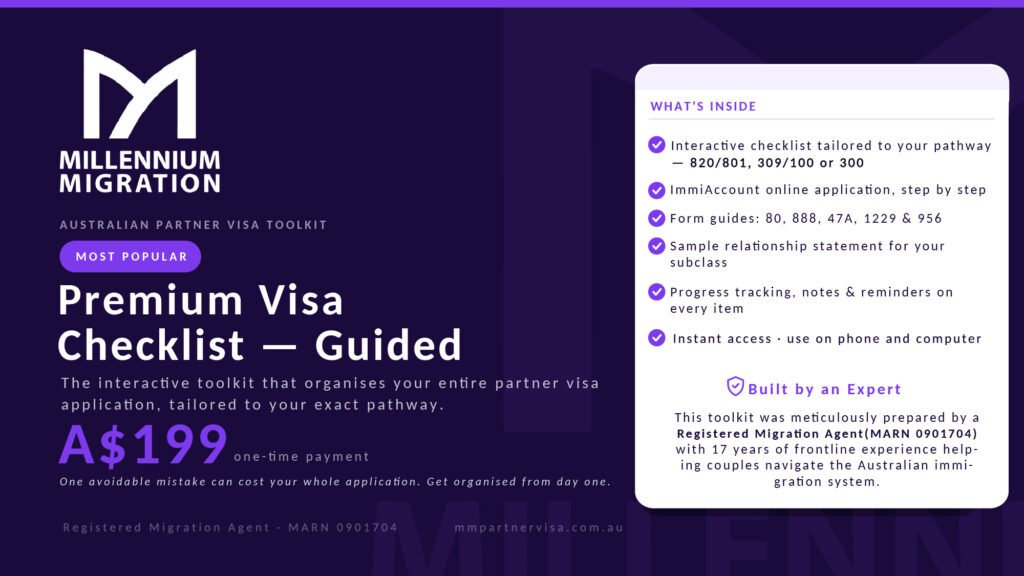
One avoidable mistake on an Australian partner visa now costs $11,710 in non-refundable fees — and months more apart from your partner. The Premium Partner Visa Checklist from Millennium Migration is the toolkit built by a Registered Migration Agent to stop that from happening. Here’s what it includes, who it’s for, and why it exists.


Key takeaways
- The Premium partner visa checklist is a subclass-specific interactive toolkit built for DIY applicants who want practitioner-grade preparation.
- Tailored versions for Partner visa (subclass 820/801) onshore, Partner visa (subclass 309/100) offshore, and Prospective Marriage visa (subclass 300) — not one generic list.
- Includes ImmiAccount visual walkthrough, form guides (80, 888, 47SP, 1229, 956), and sample relationship statements.
- Police check guidance for AFP and overseas clearances, plus health examination booking through Bupa Medical Visa Services.
- Interactive tracking on phone or computer with notes, reminders, and check-off system.
- Designed by Sam Lotfollahi (MARN 0901704) with 17 years of partner visa experience.
- Costs AUD $199 — under 2% of the $11,710 non-refundable fee it’s designed to protect.
In this guide
- What the toolkit actually is
- Why most partner visa checklists fail
- What’s inside the Millennium toolkit
- Who the partner visa checklist is designed for
- How the toolkit compares to DIY and full-agent paths
- The economics: what a mistake actually costs now
- How to use the partner visa checklist effectively
- Partner visa checklist: frequently asked questions
What the partner visa checklist actually is
A partner visa checklist is a structured list of every document, form and piece of relationship evidence the Department of Home Affairs expects before it will decide your application. Most people searching for one expect a downloadable PDF with bullet points. The Millennium toolkit is different. It’s an interactive resource built around three principles:
- Subclass-specific. A Partner visa (subclass 820) onshore application has different evidence requirements, form obligations, and timing pressures than a Partner visa (subclass 309) offshore application or a Prospective Marriage visa (subclass 300). Consequently, the toolkit adapts to which pathway you’re on.
- Interactive. Tick off completed items on your phone or laptop. Add notes about what evidence you gathered and where you filed it. Set reminders for expiry dates on police checks and medicals.
- Practitioner-built. Designed by Sam Lotfollahi — a Registered Migration Agent (MARN 0901704) with 17 years of partner visa experience. Every item on the checklist reflects a real reason applications have been refused or delayed in Sam’s practice.
The toolkit isn’t a static document, then. It’s a working companion for the entire lodgement process, from evidence-gathering through submission. If you’re still deciding which pathway applies, start with the complete Australian partner visa guide for 2026.
Why most partner visa checklists fail
Free partner visa checklists are everywhere. However, most of them fail applicants for the same four reasons.
Generic partner visa checklists ignore subclass differences
A single list that treats subclass 820, 309, and 300 identically misses the critical differences. As a result, applicants using generic lists routinely miss subclass-specific requirements. A subclass 300 applicant might overlook the marriage timing requirement. Equally, a subclass 309 applicant might not realise a bridging visa doesn’t apply offshore.
They stop at “gather documents”
Most checklists list what documents you need. Few explain how to organise that evidence into a persuasive application. However, the Department doesn’t just want a stack of papers — case officers assess whether the four relationship pillars are convincingly demonstrated.
They ignore the forms behind the application
Partner visa applications involve Forms 80, 888, 47SP, 1229, and 956 depending on your circumstances. Each form has its own rules, common mistakes, and consequences for getting it wrong. Yet most checklists barely mention them.
They don’t reflect real refusal patterns
A checklist that hasn’t been informed by hundreds of case reviews doesn’t know what actually triggers refusals. Consequently, generic checklists focus on the obvious items and miss the subtle traps — inconsistent statements between partners, missing witness Form 888s from Australian citizens, character disclosure omissions. Our guide to the most common reasons partner visas are refused sets out the full pattern.

What’s inside the Millennium partner visa checklist
The Premium toolkit includes seven core components. Each one addresses a specific failure mode Sam has seen repeatedly in refused applications.
1. Tailored step-by-step checklist for your subclass
Choose your subclass at the start — 820/801, 309/100, or 300 — and the toolkit adapts. You therefore don’t waste time on requirements that don’t apply, and you don’t miss requirements specific to your pathway. Every item includes a brief practitioner note explaining why it matters. The three pathway pages set out the underlying requirements: onshore 820/801, offshore 309/100, and prospective marriage 300.
2. ImmiAccount visual walkthrough
ImmiAccount is where you actually lodge. However, the interface confuses first-time applicants — where to attach documents, how to complete the questionnaire flow, when to pay the visa application charge. The toolkit includes screenshot-based walkthroughs so you know exactly where to click at each step.
3. Comprehensive form guides
Detailed guidance for the five forms that matter most in partner visa applications:
- Form 80 — personal particulars and character declaration (the form that trips up many applicants with omissions)
- Form 888 — statutory declaration by supporting witness (Australian citizen or permanent resident only)
- Form 47SP — application for migration to Australia by a partner (completed online through ImmiAccount, not as a downloadable PDF)
- Form 1229 — consent to grant a visa to a child under 18
- Form 956 — appointment or withdrawal of a migration agent or exempt agent
Each form guide explains the intent behind key fields, the common mistakes, and how to structure your answers.
4. Sample relationship statements
One of the hardest parts of a partner visa application is writing the relationship statement. Applicants often send generic personal essays that don’t address the four pillars of relationship evidence (financial, household, social, commitment) systematically. The toolkit includes sample relationship statements for each visa subclass — showing structure, tone, and level of detail that succeeds.
5. Police check guide for your partner visa checklist
You need a police certificate from every country where you have spent 12 months or more, cumulatively, in the past 10 years since turning 16. Two details in that sentence catch applicants out constantly. First, the time is counted cumulatively rather than consecutively — several separate stays that add up past 12 months still trigger the requirement. Second, the obligation applies to the sponsor as well as the applicant, which surprises many Australian partners who assume the character check is one-sided.
The toolkit’s police check guide covers:
- Working out which countries you and your sponsor each need clearances from, counting cumulative days rather than single stays
- Obtaining the AFP National Police Check — including the correct purpose code, which is code 33 for immigration and citizenship
- Common overseas police check processes (UK ACRO, US FBI, India, China, and more)
- Managing expiry — certificates are generally treated as valid for 12 months from issue, so timing matters
- What to do if a check reveals disclosable information
- Handling delays in overseas checks that could push your lodgement
Police checks are one of the most common causes of self-inflicted delay. Some countries issue in days; others take months. Consequently, this is the component to start first, not last.
6. Health examination guide
Every partner visa applicant must complete a health examination. In Australia these are arranged through Bupa Medical Visa Services, the Department’s migration medical services provider. Outside Australia, you must be examined by one of the Department’s approved panel physicians or clinics.
You cannot book anything until you have a HAP ID — the identifier the Department issues that lists exactly which examinations you need. Applicants who try to book first and sort the paperwork afterwards lose weeks here.
What the examination includes depends on age. A medical examination applies at every age; a chest X-ray is generally added from age 11; and an HIV test is generally added from age 15. Your HAP ID letter is the authority on which tests apply to you.
Timing matters more than most applicants realise. Health results are valid for 12 months. Booking too early therefore means results expire before your case reaches a decision, while booking too late delays lodgement. The toolkit’s health examination guide walks you through:
- Getting your HAP ID, and when the My Health Declarations service lets you complete examinations upfront
- How to book with Bupa Medical Visa Services, and how to find a panel physician if you’re offshore
- When to book relative to your lodgement date, given the 12-month validity window
- What to bring — passport, HAP ID referral letter, and prescription glasses or contact lenses if you wear them
- What the examination actually involves (medical history, physical examination, X-ray and blood tests where required)
- How results reach the Department through eMedical, typically within about five business days
- Health undertakings — what Form 815 is, when it applies, and the 28-day window it commits you to
- What happens if a health concern is flagged, including when PIC 4007 waiver considerations arise
On health undertakings: being asked to sign a Form 815 is not a refusal signal. It usually means the Department is willing to proceed provided you agree to follow-up monitoring. Signing commits you to contacting the Health Undertaking Service within 28 days of arriving in Australia — or within 28 days of your visa grant if you applied onshore. Missing that window is the risk, not the undertaking itself.
7. Interactive tracking
Access the checklist on your phone or laptop. Check off completed items, add notes about where you stored evidence, and set reminders for time-sensitive documents (police checks expire, medicals lapse, statutory declarations need dating). The toolkit therefore becomes your live workspace, not just reference material.
Who the partner visa checklist is designed for
The Premium toolkit is built for a specific type of applicant.
The DIY applicant who takes it seriously
You’ve decided not to hire a full-service migration agent. However, you’re not willing to gamble $11,710 on a Google-cobbled application. You want practitioner-grade guidance without practitioner-level fees.
The organised couple
Partner visa applications involve dozens of documents, multiple identity checks, complex relationship evidence, and strict form requirements. Couples who track this systematically avoid the last-minute panic and inconsistencies that trigger Section 56 requests.
The offshore applicant preparing for onshore transition
Prospective Marriage visa (subclass 300) holders transitioning to a Partner visa (subclass 820) need a specific document set within a narrow window. The toolkit’s 300-tailored version anticipates this transition and includes the evidence-gathering strategy from the PMV stage onwards.
Who the partner visa checklist is NOT for
The checklist won’t help if:
- You have complex character issues (previous refusals, criminal history, previous visa cancellations)
- You have compelling reasons or Schedule 3 arguments to make
- You’re applying under family violence provisions
- You’re preparing an ART appeal or Federal Circuit Court application
For these cases, full case management with Millennium Migration is a better fit. Take the 2-minute partner visa eligibility quiz to check whether the toolkit or full agent representation is right for your situation.
How the partner visa checklist compares to DIY and full-agent paths
Applicants generally choose between four paths. Here is how the toolkit compares.
| Path | Typical cost | What you get | Best for |
|---|---|---|---|
| Full DIY (free guides) | $0 | Generic PDFs, forum advice, YouTube | Straightforward cases, high research tolerance |
| Premium partner visa checklist | AUD $199 | Tailored interactive toolkit + practitioner insight | Organised DIY couples wanting confidence |
| DIY Review (agent checks your file) | AUD $999 | Professional review of your prepared application before lodgement | Self-lodgers wanting a final safety check |
| Full migration agent representation | AUD $4,200 | Case management, direct lodgement, ongoing support | Complex cases, high-stakes situations, limited time |
The toolkit sits deliberately in the middle — cheaper than an agent, but substantially better than free generic guides. It’s therefore the right fit for couples who want to self-lodge without gambling on an $11,710 outcome.
The economics: what a mistake actually costs now

Since 1 July 2026, the base partner visa fee has risen from $9,365 to $11,710 — an increase of about 25%. That fee is non-refundable regardless of outcome. The maths on avoidable mistakes has therefore shifted dramatically. Our breakdown of the 2026 partner visa fee increase covers what changed and who is affected.
The cost of a refused application
If your partner visa is refused, you lose:
- $11,710 in non-refundable visa application charge
- 3-6 months of preparation time already spent
- The processing time already invested — the median wait for a Subclass 820 decision currently sits around 16-17 months
- The ability to lodge again quickly (any second application starts a new queue at the current fee)
Total effective loss: $11,710 in cash plus potentially 2-3 years of relationship uncertainty. Current departmental figures are set out in our 2026 partner visa processing times guide.
The cost of appealing a refused application
If you appeal to the Administrative Review Tribunal (ART):
- ART review fee: $3,727
- Additional processing time: 12-24 months
- Preparing appeal submissions (usually with agent help): $2,000-$5,000
Total additional loss on top of the original $11,710: $5,700-$8,700 minimum.
Why the partner visa checklist pays for itself
The toolkit costs AUD $199. If it helps you avoid even one of the common preventable errors — an inconsistent statement, a missing Form 888 requirement, an expired police certificate, a character disclosure gap — it has protected the $11,710 investment many times over.
Practitioner note from Sam: in 17 years of partner visa practice at Millennium Migration, the refusals I see most often aren’t from complex character issues — they’re from small, preventable mistakes that a good checklist would have caught. That’s exactly what this toolkit is designed to prevent.
How to use the partner visa checklist effectively
Getting maximum value from the toolkit takes some structure. Here’s the approach Sam recommends to Millennium Migration clients.
1. Choose your subclass early
Before opening the checklist, confirm your subclass. If you’re unsure whether to lodge onshore (subclass 820) or offshore (subclass 309), or whether the Prospective Marriage visa (subclass 300) is appropriate, take the eligibility quiz first. Using the wrong subclass version wastes the toolkit’s value.
2. Start police checks first, medicals last
These two sit at opposite ends of the timeline, and reversing them is a common error. Overseas police certificates can take months to arrive, so begin them immediately. Medicals, by contrast, are valid for only 12 months from examination. Complete the evidence side of the checklist first, then book medicals as a final step before lodging.
3. Draft relationship statements using the samples as structure
The sample statements demonstrate structure and level of detail. However, do not copy them word-for-word. Case officers can detect copied templates. Use the samples to understand what a strong statement looks like, then write your own.
4. Review forms with your partner together
Inconsistencies between your Form 80 and your partner’s declarations trigger case officer scrutiny. Complete forms side-by-side, then cross-check dates, addresses, and family history before lodging. Your travel history matters twice over here, since it also determines which police certificates you each need.
5. Set the toolkit reminders
Police checks expire. Medicals lapse. Statutory declarations need recent dating. Use the interactive reminder feature to prevent lodging with expired supporting documents.
6. Escalate if you hit a complex issue
If the toolkit reveals a complexity you didn’t anticipate — a character issue, an eligibility question, a Schedule 3 barrier, a health concern that may require a waiver — contact Millennium Migration for a case-specific review. The toolkit is designed for standard cases; complex cases need practitioner judgment.
Partner visa checklist: frequently asked questions
Partner visa checklist pricing and access
How much does the Premium Partner Visa Checklist cost?
The Premium toolkit is AUD $199 — a one-time payment for lifetime access, delivered instantly through Gumroad after checkout. There is no subscription and no renewal. You can confirm current pricing on the product page.
Is the partner visa checklist a PDF or an app?
Neither. The Premium toolkit is an interactive Notion-based resource accessible on any device — phone, tablet, or laptop. You can tick off items, add notes, and set reminders wherever you are, and your progress syncs across devices.
Can I share the toolkit with my partner?
Yes. Since a partner visa involves both applicants, the toolkit is designed for shared access. You and your partner can both view, edit, and track progress together, which also helps you cross-check forms and statements for consistency before lodging.
Is there a refund policy?
Refund policies are outlined on the Gumroad purchase page. For specific questions before purchase, contact Sam directly via WhatsApp or email.
Police checks and health examinations
Which countries do I need police checks from?
You need a police certificate from every country where you have spent 12 months or more, cumulatively, in the past 10 years since turning 16. The time is counted cumulatively rather than consecutively, so several separate stays that add up past 12 months still trigger the requirement. This obligation applies to the sponsor as well as the applicant.
Does the toolkit cover police checks and health examinations?
Yes. Both are dedicated components of the partner visa checklist. The police check guide covers which countries you and your sponsor need clearances from, how to obtain them (AFP with purpose code 33, UK ACRO, US FBI, India, and more), managing the 12-month expiry, and handling disclosable content. The health examination guide walks you through getting your HAP ID, booking with Bupa Medical Visa Services, timing your examination correctly, what the exam involves, and how health undertakings work.
When should I book my health examination?
Book after your evidence is otherwise ready, not before. Health results are valid for 12 months, so examining too early risks results expiring before a decision is made. You also cannot book until the Department issues your HAP ID, which lists exactly which examinations apply to you. In Australia you book through Bupa Medical Visa Services; offshore, you use an approved panel physician.
Choosing between the toolkit and an agent
Which subclass is the toolkit for?
The toolkit is tailored to whichever subclass you’re applying under: Partner visa (subclass 820/801) onshore, Partner visa (subclass 309/100) offshore, or Prospective Marriage visa (subclass 300). Choose your pathway at the start and the toolkit adapts accordingly, hiding the requirements that don’t apply to you.
Do I still need a migration agent if I use the toolkit?
For straightforward cases, the toolkit gives you what you need to lodge a strong application independently. However, if your case involves character issues, Schedule 3 arguments, family violence provisions, health waiver questions, or previous refusals, full agent representation from Millennium Migration is a better fit. Take the quiz to assess your situation.
How is this different from the free Notion checklist Millennium Migration offers?
The free checklist is a starter overview — useful for scoping the application. By contrast, the Premium toolkit goes much deeper: subclass-specific, with ImmiAccount walkthroughs, form guides, police check and health guidance, sample statements, and interactive tracking. In short, the free version helps you decide whether to lodge; the Premium version helps you actually prepare a strong application.
Using the toolkit day to day
Does the toolkit include the actual visa application forms?
The toolkit doesn’t include the official Department of Home Affairs forms — those are only available from the Department, and Form 47SP is completed online through ImmiAccount rather than as a downloadable PDF. However, the toolkit includes detailed form guides for Forms 80, 888, 47SP, 1229, and 956, explaining the intent behind each field and how to complete them correctly.
How long does it take to complete the checklist?
Most couples complete the full checklist over 4-8 weeks of steady effort, and evidence-gathering is the longest phase. Overseas police certificates can extend that timeline considerably. However, once you have the toolkit, you can work at your own pace — there’s no expiry and no time limit on access.
What if my situation changes after I buy the toolkit?
Since the toolkit covers all three partner pathways (820/801, 309/100 and 300), you can switch pathways if your circumstances change. For example, if you were preparing a subclass 309 offshore application and end up marrying and applying onshore as a subclass 820, the toolkit adapts without an extra purchase.
Get the Premium Partner Visa Checklist — the interactive toolkit built by Sam Lotfollahi (MARN 0901704) with 17 years of practitioner experience. AUD $199, one-time.
Related reading
About the author
Sam is the founder of Millennium Migration, providing partner visa case management, decision-ready lodgement preparation, and appeal representation across Australia. He built the toolkit from 17 years of case reviews to help DIY applicants avoid the most common preventable mistakes.
Sources
- Department of Home Affairs — Partner Visa Subclass 820/801
- Department of Home Affairs — Partner Visa Subclass 309/100
- Department of Home Affairs — Prospective Marriage Visa Subclass 300
- Department of Home Affairs — Current visa pricing (base charge AUD $11,710 from 1 July 2026)
- Department of Home Affairs — Arrange your health examinations
- Department of Home Affairs — Health undertaking
- Migration Agent Registration Authority — MARA Code of Conduct and register
This article provides general information about the Premium Partner Visa Toolkit product and is current as of July 2026. Police check and health examination requirements vary by individual circumstances — always confirm your own requirements against your HAP ID letter and the Department of Home Affairs. The toolkit is a self-help resource; it does not constitute personal migration advice under the Migration Agents Registration Authority Code of Conduct. For case-specific advice, take our quiz or contact Sam directly.